Newsroom
Microstrip Power Divider: Design Principles, Advantages, and Applications
When you open your phone and listen to music online while downloading files sent by your teacher or boss, have you ever thought that you’re actually receiving one continuous signal but getting audio and text information separately? Do we really use this single signal as is? Obviously not. We need to split the signal while keeping its characteristics, and then extract the useful parts separately. This is exactly where a power divider comes in handy.
A power divider lives up to its name. It splits one input signal into multiple output ports at a fixed power ratio. It also maintains consistent phase across all output signals. power dividers are basic, vital microwave components. They carry critical functions in modern wireless communication systems. They are also indispensable for phased array radar research. At extremely high operating frequencies, equivalent circuit parts need tiny parameter values. Designers widely adopt microstrip line power dividers. This design method helps boost circuit integration levels.
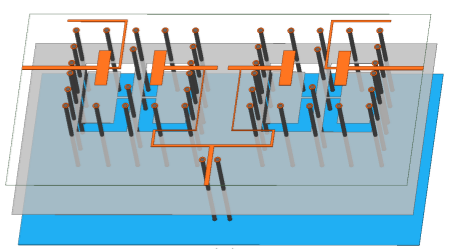
A paper published in a journal designed a passive microstrip two-way power divider based on the SIDGS structure. The overall performance of this power divider is better than existing designs and has huge application potential.
Highlights of The Power Divider Design
The core of this power divider is made up of a splitting part and a filtering part. The input signal gets evenly split by the divider, and then each piece goes through a band-pass filter for its specific frequency before coming out. The splitting and filtering parts are designed using a modified Wilkinson power divider and an SIDGS structure, respectively.
The highlight of this power divider is that it introduces an SIDGS structure on top of the basic design. The SIDGS structure comes from the DGS structure (defected ground structure). Compared to the usual microstrip designs that have a complete metal ground, the DGS structure achieves impedance transformation by carving various patterns into the metal ground. Later, this feature of DGS was extended to the design of other devices. Researchers applied it to filters, power dividers, baluns, and so on, with quite a few results.
But in actual use, DGS itself relies on etching defects into the metal ground, so the devices made from it can’t be directly applied to external metal structures, or else their basic properties would be damaged. Also, like regular microstrip structures, they can cause significant radiation at higher frequencies.
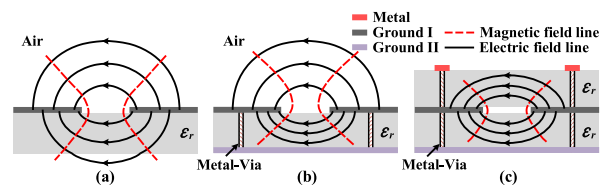
SIDGS tackles these two drawbacks by adding extra grounded metal channels. First, this ensures that the etched metal ground doesn’t come into direct physical contact with the outside, preventing it from failing. At the same time, the added metal channels help integrate the substrate, further making sure that any flaws in the metal ground aren’t affected by outside factors. Later on, real-world tests also showed that this design could solve the electromagnetic radiation issues that have been bothering researchers.
Performance Advantages
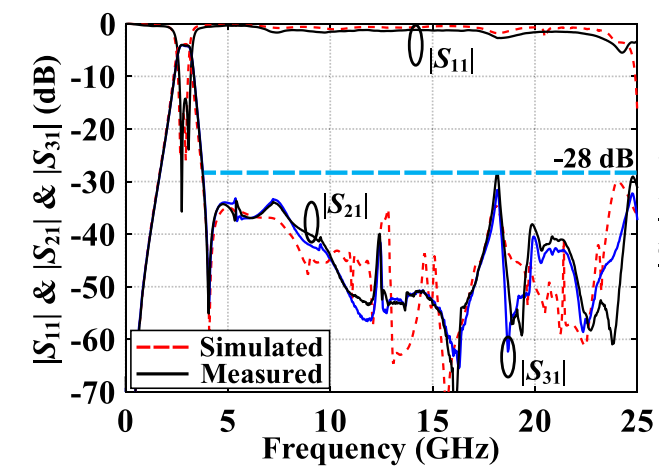
Its basic parameters are somewhat improved compared to existing power dividers, but the biggest advantage of this design is the ultra-wide stopband and minimal electromagnetic radiation introduced by the SIDGS.
As shown in the schematic in Section 1, compared to the DGS-based power divider structure, with increasing frequency, signal energy in a traditional power divider tends to be directly radiated into the air, acting somewhat like an antenna. However, in the SIDGS structure, the presence of metal channels allows the outermost two layers to communicate, creating a waveguide-like shielding effect. This effectively ‘locks’ the electromagnetic energy between the defect ground and the top and bottom metal layers, achieving an extremely wide stopband and minimal electromagnetic radiation.
Application Prospects
The divided signals are then radiated via two antennas in different directions. This solution is widely adopted in sparsely populated mountain regions. It requires no additional signal-generating devices. Therefore, it saves both power consumption and overall project cost. Phased array radar is one of the most advanced and powerful modern military radar technologies. It features high detection accuracy, long detection range, and multi-target tracking capability.

It also achieves low energy consumption, giving it great influence in military applications. The U.S. Navy’s Zumwalt-class destroyers adopt this radar technology. China’s self-developed Chinese Aegis system also applies phased array radar. The working principle of phased array radar relies on multiple processed detection signals. These signals overlap in free space and form a concentrated radar beam for target detection.
Engineers can adjust the beam direction freely by controlling part of the transmitted signals. The radar system requires numerous identical signals during the preprocessing stage. The original single source signal must be divided into multiple equal-amplitude outputs. A high-performance power divider is perfectly suited to fulfill this core requirement.
Conclusion
The core of the power divider introduced in this article lies in the use of the latest SIDGS technology. As an emerging technology, it can already be applied to the design and optimization of microwave devices like filters, power dividers, and baluns. Its low requirement for metal grounds makes it a great match for chip integration. We believe that in the near future, more innovative microwave devices based on SIDGS technology will bring us even more surprises.
As RF systems continue to advance, innovative technologies such as SIDGS are enabling more compact, efficient, and reliable power divider designs. Choosing the right power divider is essential for achieving stable signal distribution and optimal RF performance.
ZR Hi-Tech offers a wide range of high-performance RF and microwave power dividers, including standard and custom solutions for wireless communications, radar, satellite, and test applications. Contact ZR Hi-Tech today to discuss your project and find the right RF power divider for your application.