Newsroom
Why Can’t a Power Divider Be Ideally Matched at All Three Ports?
A 1-to-2 power divider ‘cannot be ideally matched at all three ports’ is essentially an inherent physical constraint of a lossless, reciprocal three-port network — starting from the fundamental principles of microwave network theory (reciprocity, unitarity), it can be derived that ‘ideal matching at all three ports’ is fundamentally incompatible with ‘the energy distribution function of the power divider.’ The specific derivation logic is as follows:
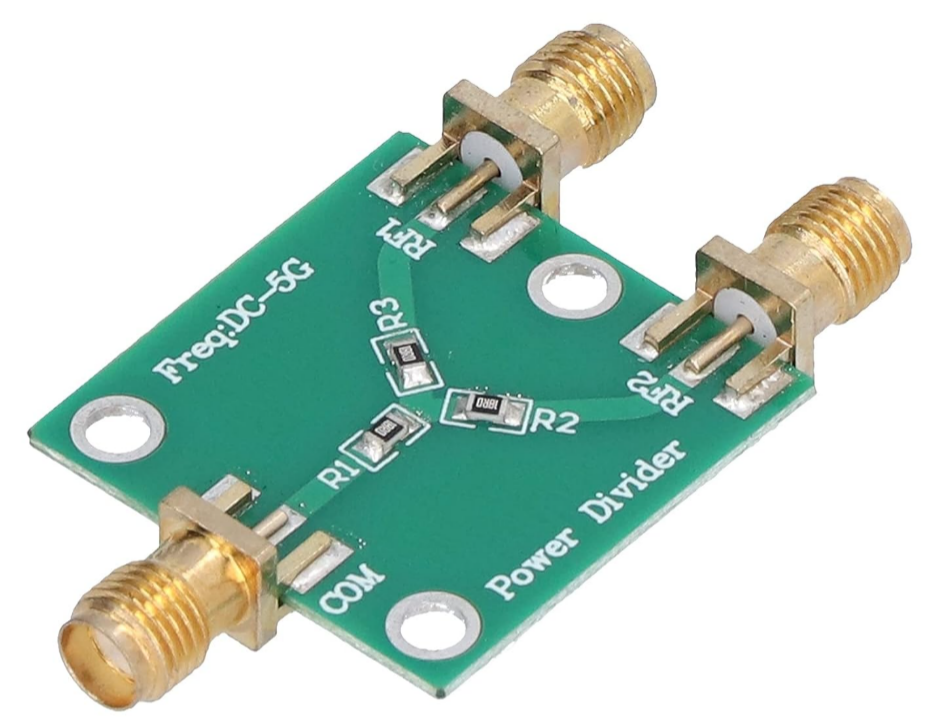
First, Clarify Two Key Premises of Power Divider
Before analysis, it is necessary to first define ‘ideal matching’ and the basic properties of the power divider, which is the basis for the derivation:
1.Definition of an ideal match:
The reflection coefficients of all three ports are 0, that is, all the ‘diagonal elements’ in the S-parameters are 0 (S₁₁=S₂₂=S₃₃=0). This means that the energy input to each port has ‘no reflection at all’ and completely enters the network.
2.Core attributes of a power divider:
As a typical passive device in the RF field, a 1-to-2 power divider must meet two conditions:
Lossless: the network itself does not consume energy (energy conservation, input power = sum of output powers);
Reciprocal: the signal transmission direction is reversible (Sᵢⱼ = Sⱼᵢ, e.g., the transmission coefficient from port 2 to port 1 = the transmission coefficient from port 1 to port 2).
Core Derivation: Deriving Contradiction from ‘Unitarity’ and ‘Reciprocity’
The S-matrix of a lossless network must satisfy unitarity (also called ‘normalized power conservation’), that is: the dot product of any two different port column vectors is 0; the magnitude of a single column vector is 1. Combined with reciprocity, the contradiction of the ‘three-port ideal match’ can be derived step by step.
Step 1: Consequences of a single-port ideal match (using port 1 as an example)
Step 2: The contradiction of dual-port ideal matching (adding 2-port ideal matching)
S₂₁² + S₂₃² = 1.
S₂₃² = S₃₁²
so
S₂₃ = ±S₃₁.
This means S₂₁ and S₃₁ must both be nonzero. If we then add the requirement for ideal matching at port 3,the full contradiction will appear clearly.
Step 3: Mathematical contradiction of three-port ideal matching (adding three-port ideal matching)
If we forcibly require that port 3 is also ideally matched (S₃₃=0), according to the unitarity constraint on the ‘third column vector’: S₁₃² + S₂₃² + S₃₃² = 1, substituting S₃₃=0 and combining with reciprocity (S₁₃=S₃₁, S₂₃=S₃₂), we get: S₃₁² + S₂₃² = 1.
However, previously from the ideal matching of port 2, we had derived S₂₁² + S₂₃² = 1. Combined with the first step S₂₁² + S₃₁² = 1, we can solve: S₃₁² = S₂₁² → S₃₁ = ±S₂₁.
At this point, if we assume the power divider is ‘equal power division’ (S₂₁=S₃₁=√(1/2)), then substituting S₂₃² = S₃₁² = 1/2 leads to: S₂₁² + S₂₃² = 1/2 + 1/2 = 1 (which seems to hold), but a physical contradiction arises:
S₂₃≠0 means there is energy crosstalk between ports 2 and 3 (energy input at port 2 leaks to port 3, and vice versa);
however, ‘three-port ideal matching’ requires no reflection and no crosstalk, yet the ‘energy distribution’ function of the power divider necessarily requires coupling between port 1 and ports 2 and 3 (S₂₁, S₃₁ are nonzero). This coupling will unavoidably cause crosstalk between ports, making it impossible to simultaneously satisfy ‘no crosstalk’ and ‘energy distribution.’
Physical Essence: The Inherent Constraints of Energy Conservation and Port Coupling
The ‘three-port ideal matching’ of a lossless reciprocal three-port network essentially requires:
no energy reflection at each port (Sᵢᵢ=0);
no energy crosstalk between ports (Sᵢⱼ=0, i≠j).
However, these two requirements completely conflict with ‘energy conservation’: if there is no coupling between all ports (Sᵢⱼ=0), the energy input to any port has ‘nowhere to go’ (it cannot be transmitted to other ports nor reflected), violating the energy conservation law of a lossless network.
The core function of a power divider is to ‘distribute the energy from one port to the other two ports,’ which necessarily requires coupling between port 1 and ports 2 and 3 (S₂₁, S₃₁≠0)—this coupling is the prerequisite for achieving ‘energy distribution,’ but it also leads to ‘crosstalk between ports’ and makes ‘three-port ideal matching’ impossible.