Newsroom
How to Select the Right RF Amplifier? How Different RF Amplifiers Differ?
When selecting the right RF amplifier for a specific application, characteristics such as gain, noise, bandwidth, and efficiency should be considered.
This article reviews the most commonly used RF amplifiers and explains how gain, noise, bandwidth, efficiency, and various functional characteristics influence amplifier selection across different applications.
RF amplifiers come in many types and form factors, each designed to meet different application scenarios. However, the sheer variety of RF amplifiers makes it far from easy to select the right device for a target application. Although gain is a key characteristic of almost every RF amplifier, it is not the only parameter to consider when choosing a device — and in many cases, it is not even the most important one.
Gain indicates how much boost an amplifier can provide to a signal, expressed as the ratio of output power to input power (in dB). It is generally specified for the amplifier’s linear mode (i.e., where changes in output power correspond linearly to changes in input power; see Figure 1). If the input signal power level of an RF amplifier is increased further, the device begins to enter the nonlinear mode and generates spurious frequency components. These interfering components include harmonics and intermodulation products (HD2, HD3, IMD2, and IMD3 in Figure 2), representing the intermodulation distortion (IMD) that appears at the output of the RF amplifier. An RF amplifier’s ability to handle different input power levels without introducing significant distortion reflects its linearity performance, which can be expressed by various parameters (see Figure 1), including:
- Output 1 dB compression point (OP1dB), which defines the output power at which system gain drops by 1 dB.
- Saturated output power (PSAT), i.e., the output power when further changes in input power no longer change the output power.
- The 2nd-order intercept point (IP2) and 3rd-order intercept point (IP3), which are hypothetical points of input (IIP2, IIP3) and output (OIP2, OIP3) signal power levels at which the power of the corresponding spurious components would reach the same level as the fundamental component
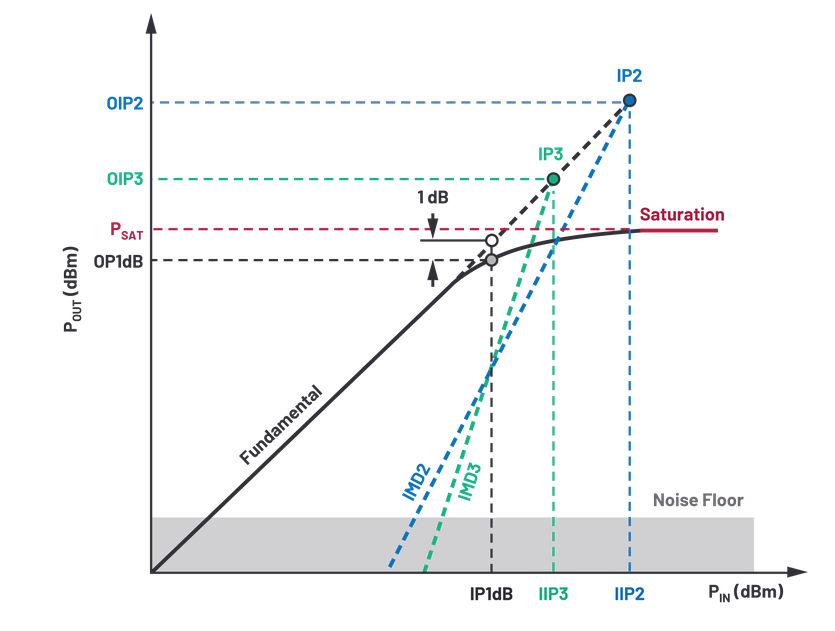
Figure 1. Output power characteristics of an RF amplifier and its nonlinear parameters
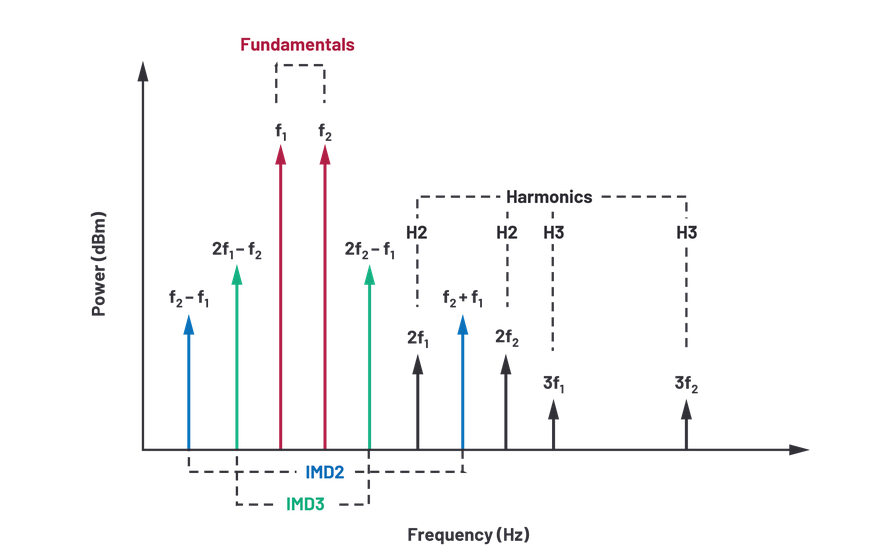
Figure 2. Harmonics and intermodulation products
Although gain describes the key function of an RF amplifier, linearity and other characteristics play an important role in determining RF amplifier selection. In fact, the choice of RF amplifier type always involves trade-offs between different design parameters. The following is a brief guide to selecting the right type of amplifier for your target use case.
Low Noise Amplifier
Low noise amplifiers (LNAs) are commonly used in receiver applications to amplify the weak signals at the front end of the signal chain that interfaces with the antenna. This type of RF amplifier is optimized to introduce minimal noise to the signal while performing this function. Noise minimization is especially important in the first few stages of the signal chain, because these stages have the greatest impact on the total noise figure of the overall system.
Low Phase Noise Amplifier
Low phase noise amplifiers add extremely minimal phase noise, making them well suited for RF signal chains that require high signal integrity. Phase noise is near-carrier noise that manifests as jitter, characterized by small fluctuations in the phase of the signal in the time domain. Therefore, low phase noise amplifiers are ideally paired with high-performance PLL frequency synthesizers in high-speed clock and LO networks.
Power Amplifier
Power amplifiers (PAs) are optimized for power-handling performance and are used in applications designed to deliver high power, such as transmitter systems. These amplifiers typically feature high OP1dB or PSAT characteristics and provide high efficiency, thereby keeping heat dissipation low.
High Linearity Amplifier
High linearity amplifiers are used to provide a high 3rd-order intercept point with extremely low spurious levels across a wide input power range. This type of device is a common choice for communication applications that use complex modulation schemes, where the RF amplifier is required to handle high peak-to-average ratios with minimal signal distortion, thereby maintaining a low bit error rate.
Variable Gain Amplifier
Variable gain amplifiers (VGAs) are used in applications that require flexible gain adjustment to adapt to changes in signal level. The VGA achieves this by providing adjustable gain, which can be stepped digitally in digitally controlled VGAs or varied continuously in analog-controlled VGAs. Such amplifiers are often used in automatic gain control (AGC) and to compensate for gain drift caused by temperature or variations in the characteristics of other components.
Broadband Amplifier
Broadband amplifiers provide moderate gain across a very wide frequency range (typically spanning several octaves), benefiting a wide range of broadband applications. These amplifiers offer a large gain-bandwidth product, usually at the cost of mediocre efficiency and noise performance.
Gain Block
Other general RF applications may also rely on gain blocks, which represent a broad category of RF amplifiers covering various frequency, bandwidth, gain, and output power levels. These amplifiers typically provide a flat gain response and good return loss. Their designs often incorporate matching and biasing circuits, so they require very few external components to integrate into a signal chain, simplifying operation.
Conclusion
This article has provided several examples of RF amplifiers and their applications. However, given the vast number of these devices and the countless applications they target, this short article inevitably omits some examples. RF amplifiers can be designed using different assembly and process technologies to provide different integration characteristics, support specific operating modes, and achieve optimized performance for a wide range of applications — from communication and industrial systems to test and measurement equipment and aerospace systems.
ZR Hi-Tech is an amplifier module manufacturer with design capability. With nearly 20 years of industry experience and support for OEM and ODM, it can provide the right amplifier solution for your project. If you have any related requirements, please feel free to contact us.