Newsroom
Gysel Power Divider: Principle, Structure & Detailed Explanation
2026-05-14
In previous articles, we learned about the Wilkinson Power Divider: Full Detailed Explanation, Features, and Uses. As one of the most classic RF power division components, the Wilkinson power divider is widely favored for its simple structure, low loss and excellent isolation. However, with the rapid iteration of modern microwave communication, 5G base station and radar systems, electronic devices are gradually developing toward wide bandwidth and high power capacity. Traditional Wilkinson power dividers can no longer fully meet the extreme power bearing and broadband working requirements of high-end RF systems.
Against this background, the Gysel power divider has gradually become a core alternative in the microwave radio frequency field. Different from the traditional equal-power divider design, the Gysel power divider adopts a unique three-branch reflection-type structure. It breaks through the power limitation of conventional power division devices, and achieves a perfect balance between wideband performance, high power handling capability and port isolation.
To help you fully understand this high-performance RF component, this article will conduct a comprehensive explanation of the Gysel power divider. We will elaborate on its unique structural design, core working principle, key performance highlights and mainstream application scenarios, and also sort out its core advantages compared with traditional power dividers. Whether you are engaged in RF circuit design, microwave technology research, or learning communication electronic components, this guide can help you systematically master the practical value of the Gysel power divider.
Gysel Power Divider: A Rising Star
The Gysel power divider is a rising star in microwave technology. It realizes signal power distribution mainly through reflection technology. Inside a Gysel power divider, different reflection coefficients are well designed. This design intelligently distributes the power of the input signal. When the input signal enters the power divider, it passes through transmission lines and loads with different characteristics. All parameters of these transmission lines and loads are precisely engineered.
As a result, part of the signal is reflected, and the rest keeps transmitting. Engineers can accurately control the reflection coefficients. This allows the input power to be allocated to each output port at a preset ratio. For instance, you can adjust key parameters. These include the length and characteristic impedance of transmission lines, as well as load resistance. Tweaking these parameters helps achieve different power division ratios. It can satisfy a wide range of practical application needs. This power distribution method relies on reflection principles. It also gives the Gysel power divider distinctive performance advantages.
Unique Structure
The Gysel power divider has a unique layout with three main branches. Two of the branches are connected in series. The third branch is parallel to the first two. The input signal first flows into the first branch. One portion of the signal travels along the second branch and then into the third branch. The remaining signal reflects back to the first branch. The third branch is critical for signal power distribution. It splits the internal signal equally to all output ports.
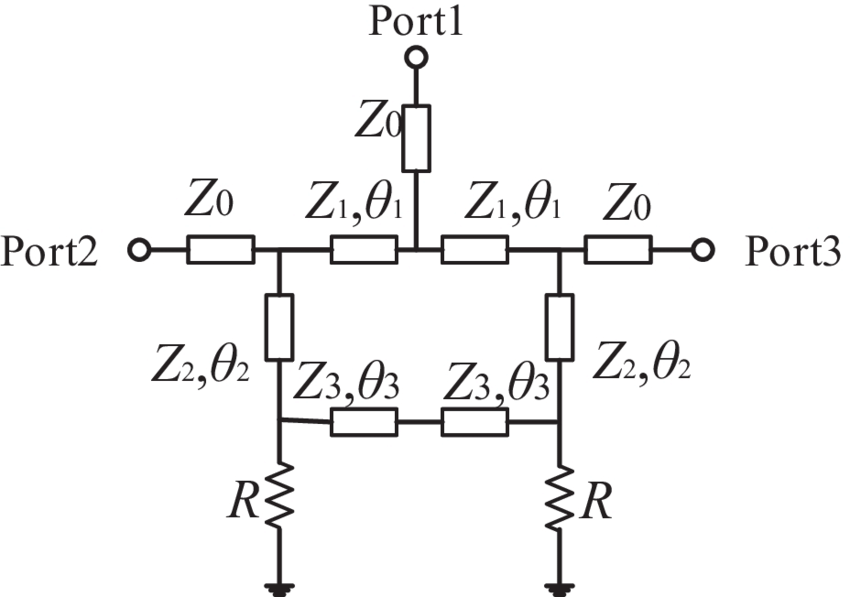
Take the common microstrip Gysel power divider as an example. Its three branches are typically constructed with microstrip lines. Engineers can rationally design the width and length of these microstrip lines. They can also optimize the connection mode of the lines. This meets all key performance indicators of the power divider. The Gysel power divider benefits from this unique structural design. It can complete basic power distribution. It also effectively controls signal transmission and reflection. This further enhances the overall performance of the power divider.
Performance Highlights of Gysel Power Divider
The Gysel power divider delivers many outstanding performance highlights. It offers excellent broadband performance. It maintains stable power division across a wide frequency range. Its relative bandwidth generally exceeds 30%. Optimized designs can achieve an even broader bandwidth. This makes it ideal for multi-band communication systems. It satisfies power distribution needs for signals in different frequency bands. The Gysel power divider also features high power handling capability. Its special structure and proper load configuration allow it to tolerate high input power. For continuous wave operation, stripline and microstrip Gysel dividers have power limits. These limits depend on transmission line breakdown voltage and heat dissipation.
Proper design optimization can effectively improve its power handling capacity.It provides high isolation between output ports, typically above 20 dB. Low interference exists among output signals. This ensures independent and stable operation of each port. The device also achieves good port matching performance. Both input and output ports maintain low reflection coefficients. The input port return loss is usually better than -20 dB. The output port return loss can reach below -15 dB.These characteristics support highly efficient signal transmission.
Application Scenarios of Gysel Power Divider
Gysel power dividers are widely used in high-power and wideband fields. Typical applications include microwave communication and radar systems. Communication technology keeps advancing. Modern systems raise higher demands for signal bandwidth and power. Gysel power dividers feature wide bandwidth and high power handling. They perfectly meet power distribution needs for multi-band and high-power microwave signals. 5G base stations need to split high-power transmitter signals to multiple antennas.
Gysel power dividers can realize this function efficiently. They maintain stable signal transmission and reliable coverage. Radar systems transmit and receive high-power RF signals. Gysel power dividers allocate transmitter power to multiple antenna units. This improves radar detection performance and anti-interference capability. In phased array radar systems, Gysel power dividers support precise antenna array feeding. They help achieve fast target detection and real-time tracking.
Conclusion
The Gysel power divider is an upgraded alternative to traditional Wilkinson dividers. Its unique three-branch reflection structure effectively overcomes the bandwidth and power limitations of conventional RF power dividers.
It features outstanding comprehensive performance, including over 30% relative bandwidth, high power handling, high port isolation and low return loss. It ensures stable and efficient signal transmission for microwave systems.
Due to these advantages, Gysel power dividers are widely used in 5G base stations, microwave communication and phased array radar systems. They perfectly meet modern demands for wideband and high-power RF applications.
Overall, the Gysel power divider is a high-performance and cost-effective component for advanced RF circuit design. With the continuous development of communication and radar technology, it will see increasingly extensive applications.
If you need high-quality and customized Gysel power dividers for your projects, welcome to contact ZR Hi-tech. We offer reliable RF component solutions and professional technical support to fit your system requirements.