Newsroom
How Poor Thermal Management Affects RF Power Amplifier (PA) Performance
Thermal management is a critical design consideration for RF power amplifiers (PAs). Poor heat dissipation can increase device temperature and lead to lower gain, reduced output power, degraded linearity, higher noise, frequency drift, and deterioration of key RF performance indicators such as ACLR, EVM, SNR, and phase noise. This article explains how PCB grounding and GND via design influence PA thermal performance and the resulting impact on RF system performance.
How PCB Grounding Affects RF PA Thermal Management
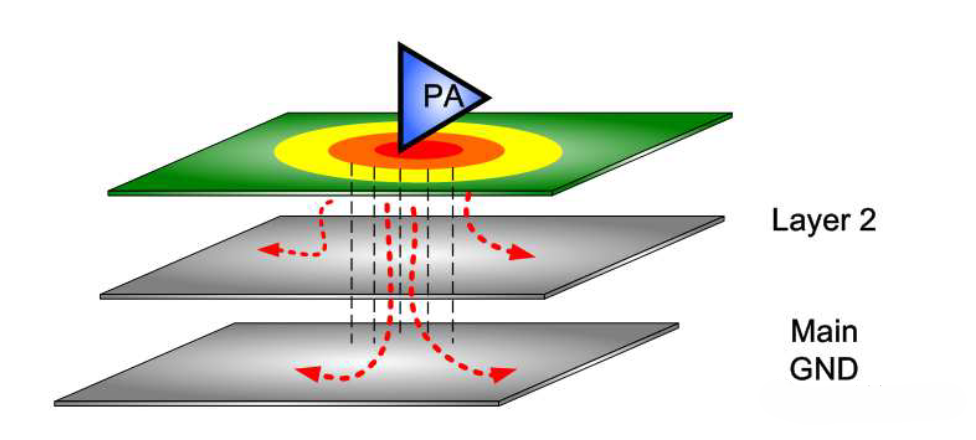
From a thermal perspective, the ground plane beneath an RF PA provides a shorter thermal path for heat to flow through GND vias into the lower-layer ground plane. Part of the heat can therefore be dissipated through the lower-layer ground before the remaining heat is transferred to the Main GND.
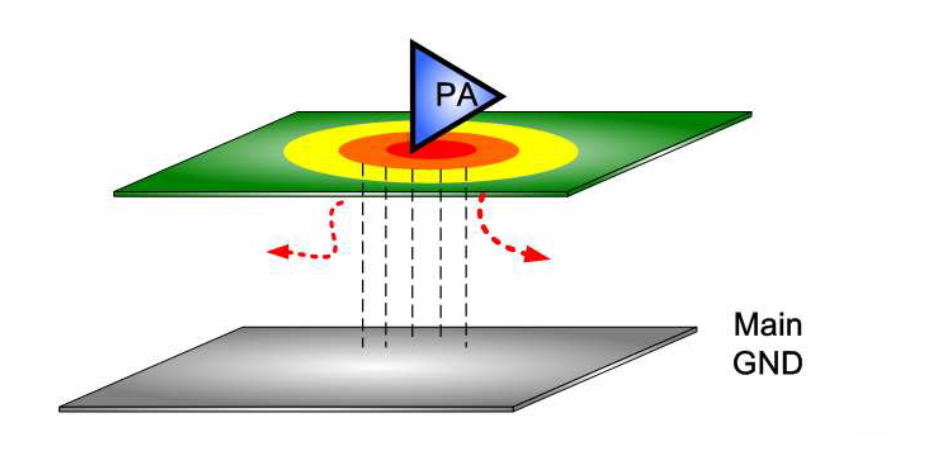
When there is no continuous ground plane directly beneath the PA, the thermal path becomes longer and less effective.
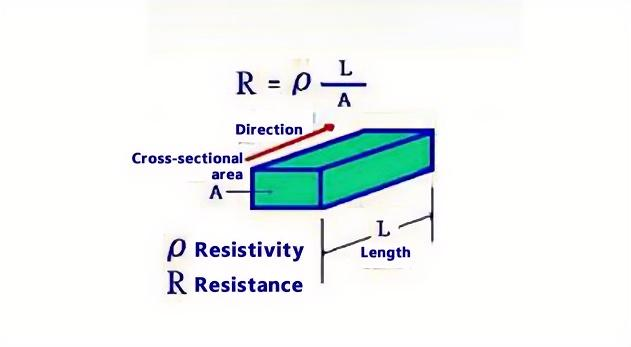
Electrical resistance increases with conductor length. A longer conductive path has higher resistance and can result in greater heat generation. In a PCB stack-up, the GND via path from Layer 1 to the Main GND is longer than the path from Layer 1 to Layer 2.
If the PA relies mainly on the Main GND for heat dissipation, the longer GND via path introduces higher resistance and makes heat transfer less effective. With a ground plane on the lower layer, heat can travel through a shorter, lower-resistance path. Without that ground plane, the longer thermal path reduces heat dissipation efficiency. In the worst case, heat can accumulate underneath the PA instead of being effectively transferred to the Main GND.
What Happens When an RF PA Overheats?
When an RF power amplifier cannot dissipate heat effectively, several RF performance parameters can deteriorate.
- Reduced PA Gain and Output Power
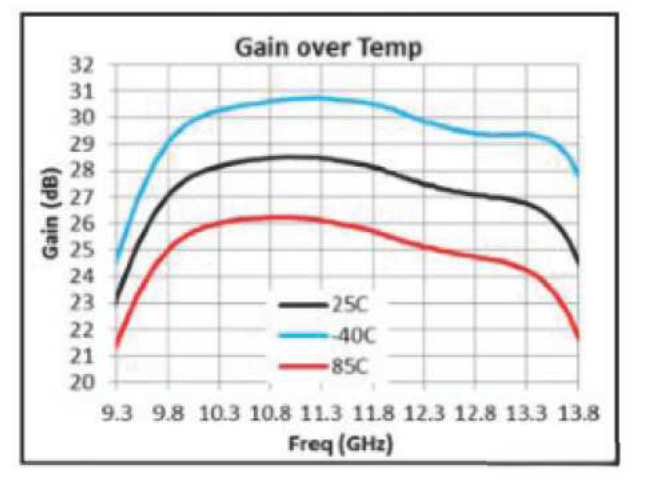
Poor thermal management can cause PA gain to decrease, resulting in lower output power. For RF systems with strict output-power requirements, this can directly affect the ability of the transmitter to maintain the required target power.
- Degraded PA Linearity and TX Performance
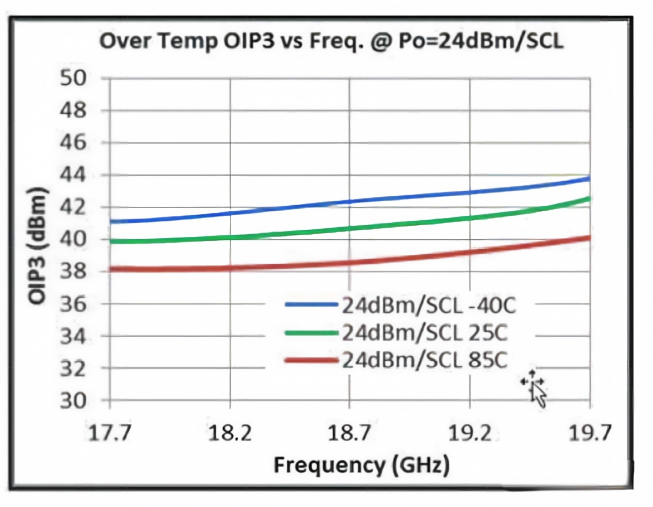
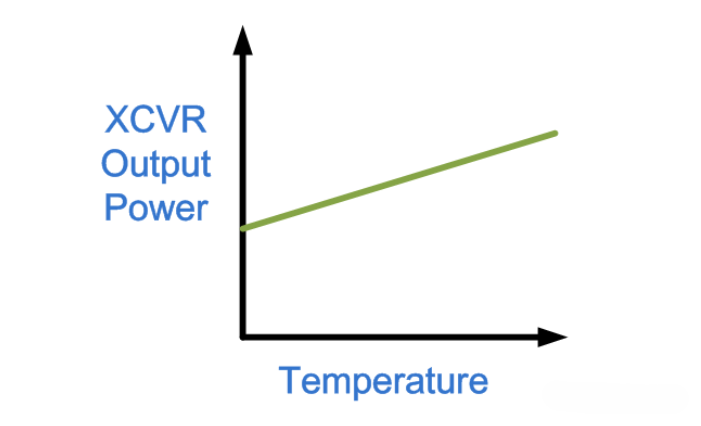
As PA temperature increases, PA linearity deteriorates, which can degrade the transmitted signal. For communication standards such as GSM, WCDMA, and LTE, where output power and signal quality requirements are strict, temperature compensation may be required to maintain output power at elevated temperatures.
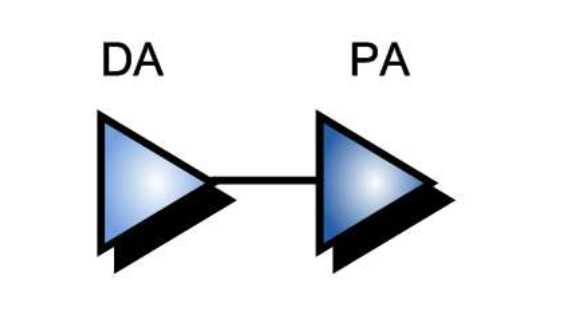
However, increasing the DAC/RGI setting to compensate for reduced PA output power can increase the transceiver output level. Because the PA input is the DA output, a higher DA output level can also worsen DA linearity.
As a result, ACLR and EVM at the PA input may already be degraded before the signal reaches the PA. Because the PA is a major source of RF nonlinearity, the signal can deteriorate further after amplification. The additional temperature-induced degradation in PA linearity can therefore further reduce overall TX performance.
- Increased Thermal Noise and Reduced RX Sensitivity
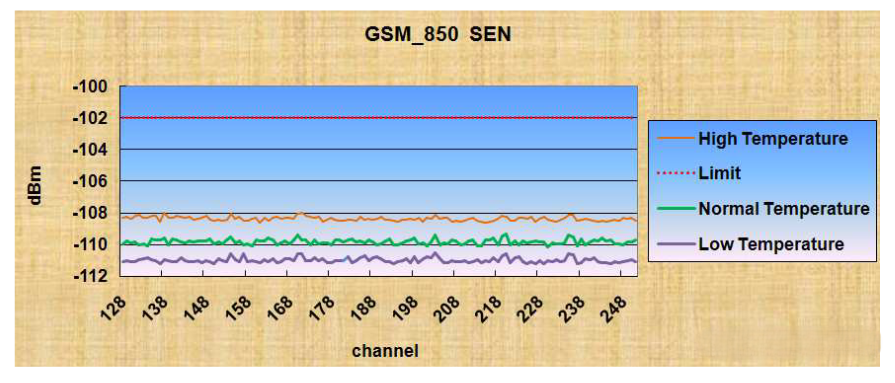
Higher temperature also increases thermal noise, which can reduce receiver (RX) sensitivity.
Although GSM uses time-division multiplexing and TX and RX do not operate simultaneously, the PCB temperature does not instantly return from an elevated temperature to room temperature when TX is turned off. Heat generated by the PA can continue to raise PCB temperature and therefore negatively affect RX sensitivity during the subsequent RX period.
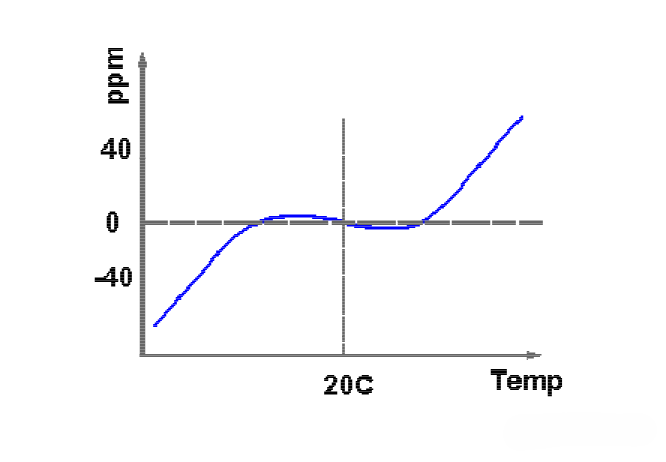
- XO Frequency Drift and Frequency Error
High temperature can cause the crystal oscillator (XO) to experience frequency drift, which can result in frequency error. This is another reason why thermal behavior should be considered when designing an RF transceiver PCB.
- Duplexer Frequency Response Shift and Main-Frequency Attenuation
If a duplexer is placed very close to the PA and thermal dissipation is inadequate, the temperature rise can shift the duplexer’s frequency response. This shift may cause significant attenuation of the main-frequency power.
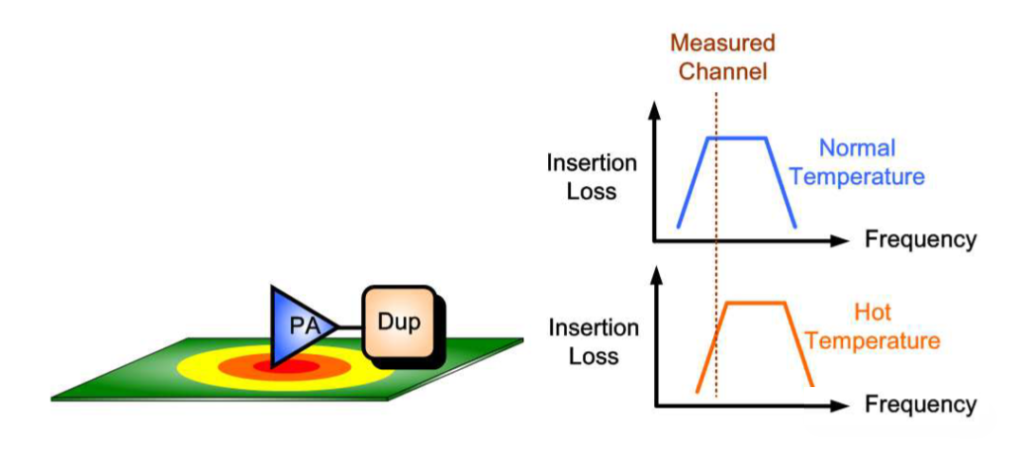
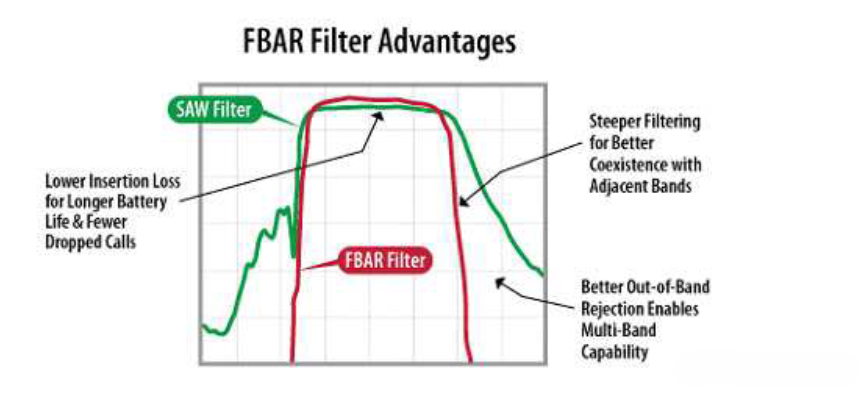
The effect can be particularly noticeable in technologies such as FBAR, where deep out-of-band rejection is used. Temperature-dependent changes in the frequency response can therefore become an important consideration when the duplexer is located close to a heat-generating PA.
- Higher VCO Phase Noise and Degraded EVM
VCO phase noise can increase at elevated temperatures. Higher phase noise raises the signal noise floor, which reduces the signal-to-noise ratio (SNR).
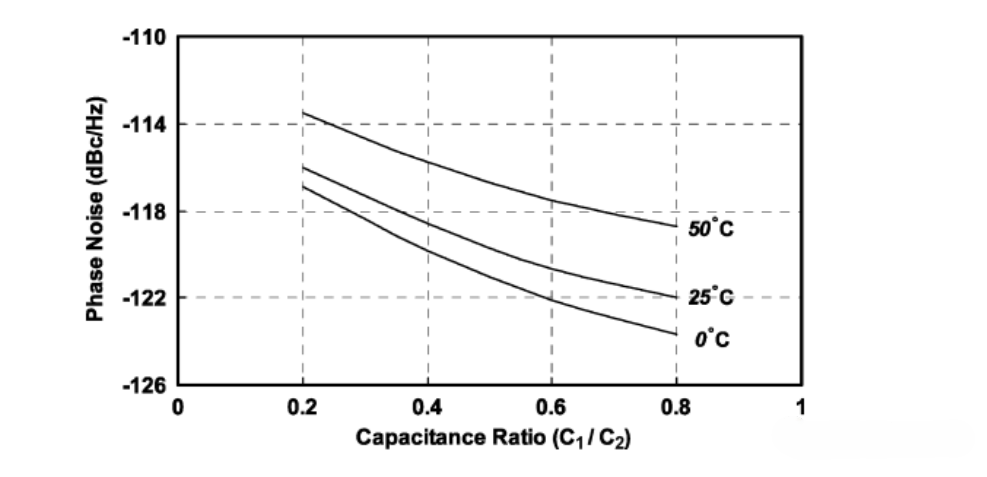
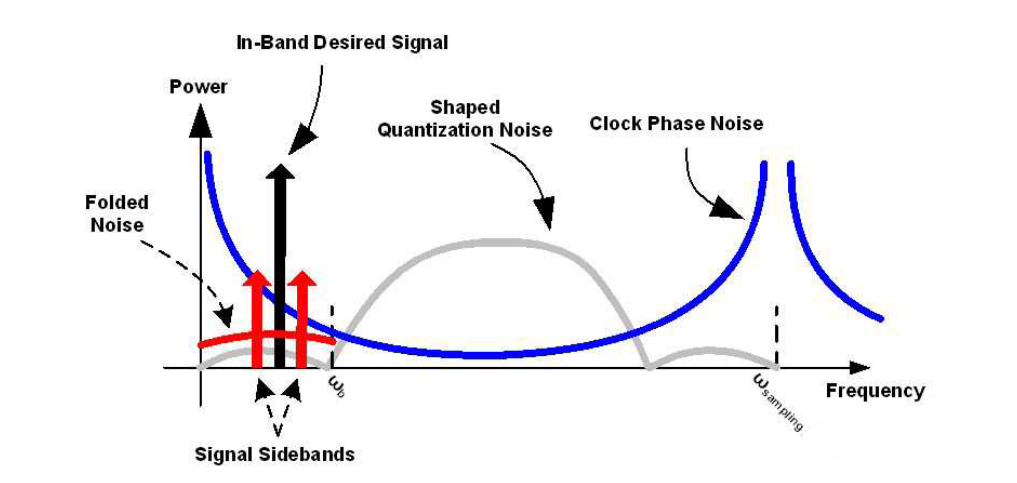
A lower SNR can in turn contribute to EVM degradation. Therefore, poor RF thermal management can affect not only PA output power and linearity, but also the overall signal-quality performance of the RF transceiver.

Conclusion: Why RF PA Thermal Management Matters
Effective thermal management is an important part of RF power amplifier and RF transceiver PCB design. A suitable ground-plane structure and low-resistance GND via thermal path can help transfer heat away from the PA and reduce the risk of temperature-related RF performance degradation.
Poor PA thermal management can affect multiple parameters, including gain, output power, linearity, ACLR, EVM, RX sensitivity, frequency accuracy, duplexer response, VCO phase noise, and SNR. For RF and microwave applications, thermal design should therefore be considered together with RF layout, grounding, component placement, and overall system performance.
At ZR Hi-TECH, we provide customizable thermal management solutions for RF power amplifiers to help customers achieve reliable performance under demanding operating conditions.