Newsroom
Can Your Directional Coupler Really Withstand Harsh Outdoor Conditions?
Outdoor macro base stations, coastal communication lines and satellite ground stations all face tough environments. Passive hardware installed here is fully exposed to natural hazards. Ordinary commercial passive parts easily fail under harsh factors. These include extreme temperature swings, long-term UV rays, high humidity and salt mist. Poorly built directional coupler will bring serious failures in harsh settings. Moisture seepage causes short circuits inside the air cavity. Thermal expansion and contraction result in impedance mismatch. Oxidation on connectors leads to severe passive intermodulation (PIM).
ZR Hi-tech sets strict standards for outdoor passive components. We do not only guarantee basic outdoor survivability. Our products keep steady electrical performance under severe environmental stress. This article explains how industrial outdoor directional couplers resist extreme field conditions.
Directional Coupler Built for Moisture & Dust Resistance
When a coupler sits fully exposed to heavy rain or ice, vague labels like “weatherproof” offer little real guarantee. If water seeps into its coaxial cavity, the dielectric constant shifts immediately. This ruins coupling precision and throws insertion loss far off specification.
ZR Hi-Tech sets strict standards for outdoor directional couplers. All our models adopt an integrated sealed structure, meeting or surpassing IP67 protection ratings. Here are our core engineering waterproof measures: We fit high-elastic silicone O-rings on all mechanical seams and connector surfaces. The housing relies on a high-pressure integrated gasket for full sealing. We avoid outdated waterproof tape, which ages and loses sealing performance over time. This tight seal keeps the inner air cavity completely dry. It stays reliable even under long-lasting heavy rain or high-pressure water cleaning.
Directional Coupler Built for Corrosion Resistance
- We fit high-elastic silicone O-rings on all mechanical seams and connector surfaces.
- The housing relies on a high-pressure integrated gasket for full sealing.
- We avoid outdated waterproof tape, which ages and loses sealing performance over time.
Directional Coupler Built for Heat Stability
Outdoor hardware deployed in deserts or high-altitude areas has to withstand huge temperature swings between day and night—sometimes over 40°C in a single day. As the metal expands and contracts with heat, the physical tolerances inside the coupler can shift by microns.
Structural risk: if the expansion coefficients of the internal coupling strips don’t match the cavity walls, the coupling value will drift. At the same time, if the tension in the internal center conductor loosens, it can cause intermittent PIM and return loss anomalies.
Our solution: we use high-grade aluminum alloy or non-magnetic brass that’s been stress-relieved for the coupler body and strictly match the thermal expansion coefficients of all parts. The internal microstrip or airline structures are mechanically locked in place to ensure that amplitude balance and directivity stay perfectly flat and linear across a temperature range from -40°C to 85°C.
Mechanical Rigidity Against Wind Load and Vibration
When couplers are mounted high on communication towers or utility poles, they need to withstand long-term wind loads, as well as structural micro-vibrations caused by nearby heavy traffic or machinery.
Reinforced connectors: Our couplers come with heavy-duty 4.3-10 or N-type female connectors and are physically reinforced at the base, allowing them to handle extremely high torque and shear stress. This effectively prevents internal solder joints or crimp points from cracking when exposed to strong storms or if construction workers pull hard on the cables.
Sturdy mounting structure: Each unit comes with integrated, pre-drilled mounting holes and optional corrosion-resistant stainless steel brackets, supporting secure installation on walls, poles, or crossarms. Outdoor selection technical checklist:
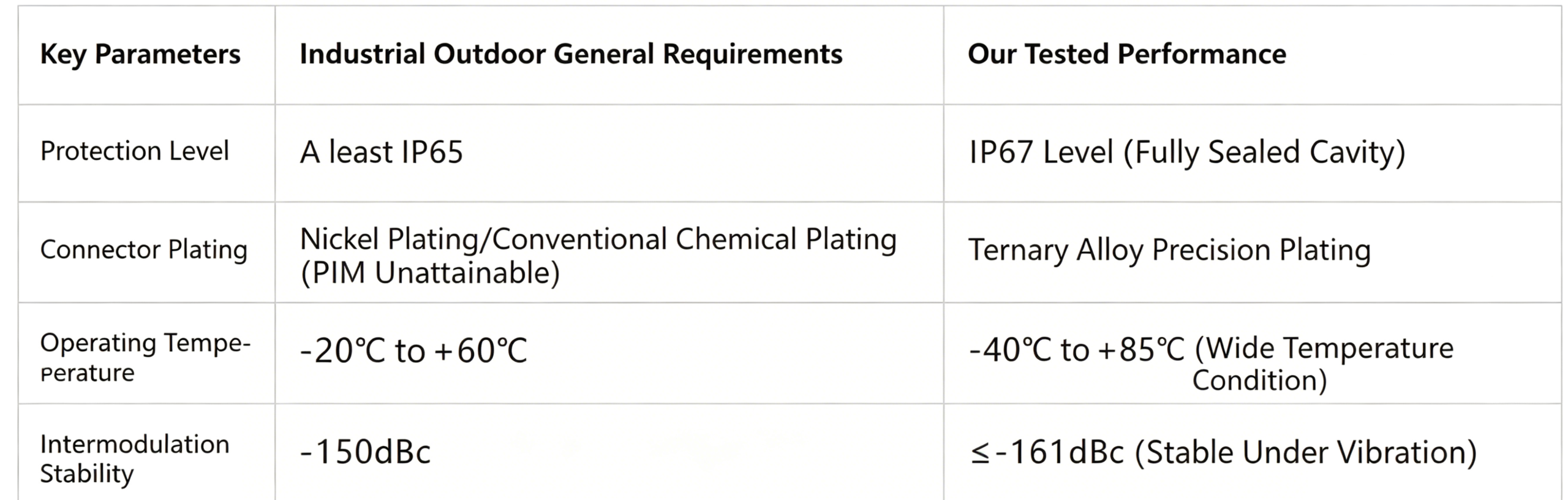
Before deploying directional couplers in uncontrolled outdoor environments, make sure they meet the following industrial-grade benchmark criteria: