Newsroom
Can a Power Divider Be Used as a Combiner? Key Precautions
In the field of RF design, using a power divider in reverse as a power combiner is a common and theoretically reasonable engineering practice—the core basis is the reversibility of the functions of a lossless reciprocal network (i.e., the physical processes of ‘splitting’ and ‘combining’ can be mapped in reverse).
Here’s the simplified, split version for clarity: However, one core premise must be met. The special requirements of the combining scenario must match the inherent design limitations of the power divider. Combining scenario requirements include: – Power addition – Port isolation – Frequency band coverage Power divider limitations include: Rated power -Isolation bandwidth – Impedance specifications If these parameters do not match, a chain of problems can occur: Mild issues: Signal distortion and reduced signal-to-noise ratio, such as standing wave deterioration caused by port reflection. Severe issues: Permanent device damage (e.g., isolation resistors burned out by exceeding power capacity) and even complete RF system failure (e.g., signal source self-excitation due to crosstalk).
The following are some points to note, for reference.
Isolation of the Input Port of the Power Divider (to prevent signal crosstalk and source damage)
One of the core requirements of a combiner is ‘to avoid mutual interference between the two input signal sources,’ which entirely depends on the port isolation of the power divider (usually referring to the isolation between ports 2 and 3, i.e., S₂₃/S₃₂), and this is the most critical consideration.
1. The role of isolation
If the isolation is insufficient (e.g., <15 dB), the signal input at port 2 will be coupled to port 3 through the ‘coupling path’ (and vice versa), resulting in:
- Signal source damage is a major risk. When two high-power sources are used, such as base station power amplifiers or radar transmitters, crosstalk power may exceed the signal source’s reverse power tolerance. Most RF sources can only withstand a few milliwatts of reverse power. Excess crosstalk will directly burn out the output stage of the signal source.
- Signal quality will be degraded. Crosstalk signals mix with normal input signals. This lowers the signal-to-noise ratio of the combined output. It also increases signal distortion, such as a higher bit error rate for digital signals.
2. Suggestions for Improvement
- Choose **Wilkinson-type power splitters** first for combining scenarios. – They achieve high port isolation via an isolation resistor. – Typical isolation: ≥20 dB for commercial models, and over 30 dB for high-performance versions. This is much better than branch-line power splitters without isolation resistors, which usually only offer 10–15 dB isolation.
- Pre-test isolation before use. – Use a network analyzer to measure isolation between ports 2 and 3. – Verify that isolation meets your system’s requirements at the working frequency of the combined signal. – For example, aim for ≥25 dB in high-power scenarios.
- Avoid isolation resistor failure in Wilkinson power dividers. The isolation resistor is power-sensitive and can degrade over time, especially after high-power use. You can check it with a multimeter: – If the measured resistance deviates from its nominal value, the resistor has failed. A failed resistor will drop isolation to near zero, making the divider completely unsuitable for combining.
Power Divider’s Power Capacity of the Power Divider (to prevent device damage)
A power divider’s rated power includes average power and peak power, such as 50W average and 100W peak. This rating is designed for power splitting mode: power enters Port 1 and splits equally to Port 2 and Port 3. However, when used as a combiner, output power equals the sum of the two input powers. This can easily exceed the divider’s rated power limit.
1. The Risk of Power Superposition
- If the two input signals are in phase and at the same frequency, the output power at port 1 after combining ≈ P₂ P₃ (in the ideal lossless case); even if they are at different frequencies or out of phase, the output power is at least |√P₂ – √P₃|², and the ‘maximum possible power’ still needs to be considered.
- If the combined power exceeds the ‘rated average power / peak power’ of the power divider, it will cause:
Conductor burnout of microstrip/coaxial cable (overcurrent and overheating);
Insulation resistance, dielectric substrate (such as PTFE) breakdown (electric field strength exceeds limit under high power);
Long-term power overload can cause the S-parameters of the power splitter to drift permanently (such as deterioration in matching performance).
2. Improvement Suggestions
- Calculate the maximum combined power carefully. Reserve 10% to 20% power redundancy based on the total input power, and account for actual signal loss. Make sure the final combined power never exceeds the power divider’s rated capacity.
- Differentiate between average power and peak power. For pulse signals like radar and pulsed communication, pay close attention to the power divider’s peak power rating. Its peak power capacity is usually 5 to 10 times the average power. This prevents device damage from exceeding peak power limits.
- High-power applications need dedicated power divider models. When combined output power reaches 100W or higher, such as base station combining, use a high-power Wilkinson power divider. These feature a copper housing, high-power resistors and thickened microstrip lines. Do not use ordinary PCB chip power dividers for such scenarios.
Port Impedance Matching (Preventing Reflection and Standing Wave Deterioration)
The power divider ‘cannot ideally match all three ports,’ but in engineering, it is necessary to ensure ‘the matching of key ports in the combiner scenario,’ otherwise reflections will occur, creating standing waves and affecting signal transmission efficiency.
1. Consequences of poor matching
- Input port (ports 2 and 3) mismatch: The output power of the signal source cannot be efficiently injected into the power divider, and part of the power is reflected back to the source, causing the source’s ‘output power to be unstable’ (for example, the RF source may self-oscillate due to reflection);
- Output port 1 mismatch causes serious issues. Combined power cannot transfer efficiently to loads like antennas or receivers. Some power reflects back into the power divider. It mixes with input signals and forms standing waves, which worsen signal distortion.
2. Improvement Suggestions
-
Keep impedance matched across the entire link: signal source, power splitter, and load.Commercial power splitters usually have standard impedance:
- 50Ω for general RF applications
- 75Ω for cable TV systems
Make sure the output impedance of the signal source and the input impedance of the load both match the splitter’s impedance. - Control Voltage Standing Wave Ratio (VSWR): At the operating frequency, measure the VSWR of ports 2 and 3 (input) and port 1 (output), which needs to meet ≤1.5 (corresponding to a return loss ≥14dB), and for high-performance scenarios, it should be ≤1.2 (return loss ≥20dB).
- Avoid ‘no load’ or ‘wrong impedance connection’: When combining ports, ports 2 and 3 must be connected to a signal source (or matched load) simultaneously, and port 1 must be connected to a load; it cannot be left open — no load will cause the port reflection coefficient to equal 1, resulting in full reflection and instant device damage.
Frequency and Bandwidth
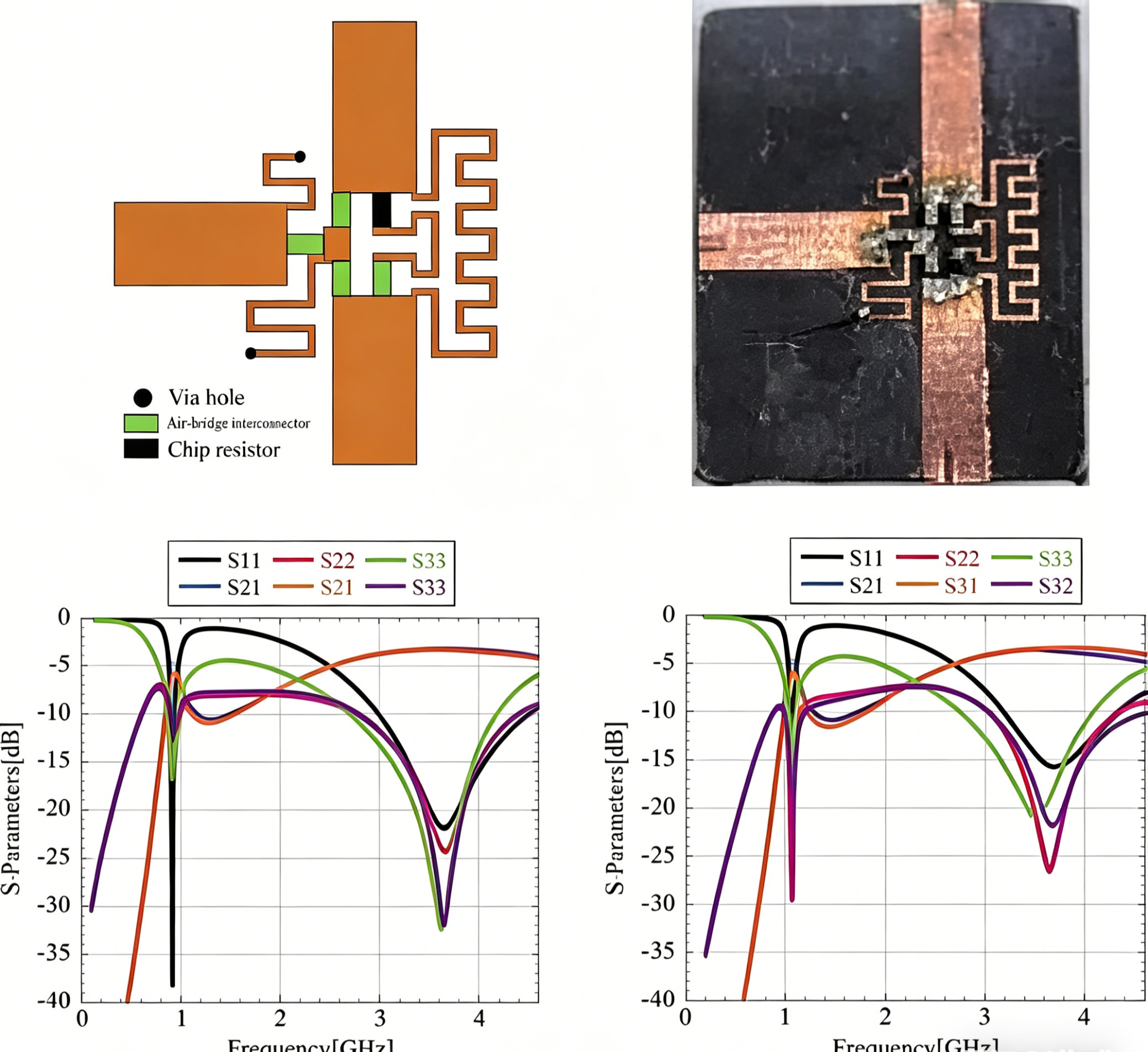
The “operating frequency band” of a power divider is designed according to the “power division mode,” and the frequency of the combined signal must fall within this band; otherwise, key parameters (isolation, insertion loss, matching) will deteriorate sharply.
1. Frequency mismatch issues beyond the band
- If the frequency of the combined signal is higher or lower than the design band of the power divider, there will be a sudden increase in insertion loss (for example, from 0.5dB to over 3dB) and a sudden drop in isolation (for example, from 25dB to 10dB), resulting in extremely low combining efficiency;
- Narrow bandwidth brings obvious limitations. If two combined signals have a large frequency gap, such as 1GHz and 2GHz, a narrowband power divider cannot work well. For example, a narrowband divider with only 100MHz bandwidth cannot maintain good performance for both signals at the same time.
2. Suggestions for improvement
- Check the frequency parameters of the power divider: Refer to the ‘center frequency’ and ‘relative bandwidth’ in the datasheet (e.g., center frequency 2.4GHz, bandwidth 2.3-2.5GHz) to ensure that the frequencies of both combined signals are within this range;
- for wideband combination, choose a ‘wideband power divider’: if the combined signals are multi-band (e.g., 2.4GHz and 5GHz Wi-Fi signals), a ‘wideband Wilkinson power divider’ should be selected (e.g., bandwidth 1-6GHz) to avoid the frequency limitations of a narrowband power divider.
Power Divider’s Phase, Intermodulation, and Heat Dissipation
Depending on the differences in combiner scenarios (such as same-frequency combining and high-power combining), the following details also need to be considered:
1. Co-phased combining: control the phase difference (to improve synthesis efficiency)
If the two signals combined are of the same frequency (such as multiple power amplifiers combined in a base station), it is necessary to ensure that the two signals at ports 2 and 3 of the power divider have “phase alignment”:
- Phase difference = 0° (in phase): output power after combining ≈ P₂ + P₃ (ideal case), resulting in the highest combining efficiency;
- Phase difference = 180° (out of phase): output power after combining ≈ |P₂ – P₃|, and if P₂ = P₃, the power cancels out, producing almost no output;
- In practice: a “phase compensation line” is used to adjust the path length of the two signals, ensuring a phase difference ≤ 5° (for high-performance scenarios).
2. Different frequency combining: Suppress intermodulation products (prevent interference)
If the two signals combined are at different frequencies (such as f1 and f2), attention must be paid to the ‘nonlinearity’ of the power combiner, which may produce ‘intermodulation products’ (such as 2f1-f2, 2f2-f1):
- If the intermodulation products fall within the ‘useful signal frequency band’ (such as the receiver’s receiving band), they can cause interference.
- In practice: choose a ‘low nonlinearity’ power combiner (for example, using oxygen-free copper material and gold-plated contacts), or add a ‘band-pass filter’ after combining to filter out the intermodulation products.
3. High-Power Combining: Enhanced Heat Dissipation Design
When the combined power is ≥50W, the power divider will generate heat due to ‘conductor loss’ and ‘isolation resistance loss’. If heat dissipation is poor:
- Increased temperature will cause resistance value drift and increased dielectric loss, further deteriorating the parameters;
- Long-term high temperature can lead to solder joint detachment and casing deformation.
- Practical operation: install the power divider on a metal heat sink, or choose a high-power model ‘with heat dissipation fins’ to ensure the operating temperature is ≤60°C.
Conclusion
Reusing a power divider as a combiner is widely adopted in RF engineering due to network reciprocity, yet it cannot be applied blindly.
Key factors must be fully considered: port isolation, power handling capacity, impedance matching, operating frequency bandwidth, phase consistency, intermodulation performance and heat dissipation. Mismatched parameters will cause signal interference, standing wave deterioration, device burnout and even system failure.
Correct model selection, parameter verification and standard installation ensure stable performance when using power dividers as combiners. For professional power divider solutions and technical support, feel free to contact ZR Hi-tech.