Newsroom
How to Choose a Power Divider? 5 Essential RF Parameters You Need To Know
In RF links, power divider is almost one of the most common passive components. They’re essential for local oscillator distribution, antenna feeding, power combining, and signal monitoring in test systems.
Many engineers select power dividers only by port count and frequency range. They tend to overlook other important parameters. After PCBs return for testing, unexpected issues often appear. Insertion loss fails to meet expectations. Isolation performance is insufficient. Amplitude imbalance between output ports becomes significant. This article breaks down these frequently‑neglected parameters one by one.
Insertion Loss: Don’t Confuse Theoretical Distributed Loss With Device Insertion Loss
A power splitter divides one signal into N paths, and theoretically, each output gets 1/N of the input power. This attenuation, dictated by physics, is called ‘distribution loss,’ not the device’s ‘insertion loss.’
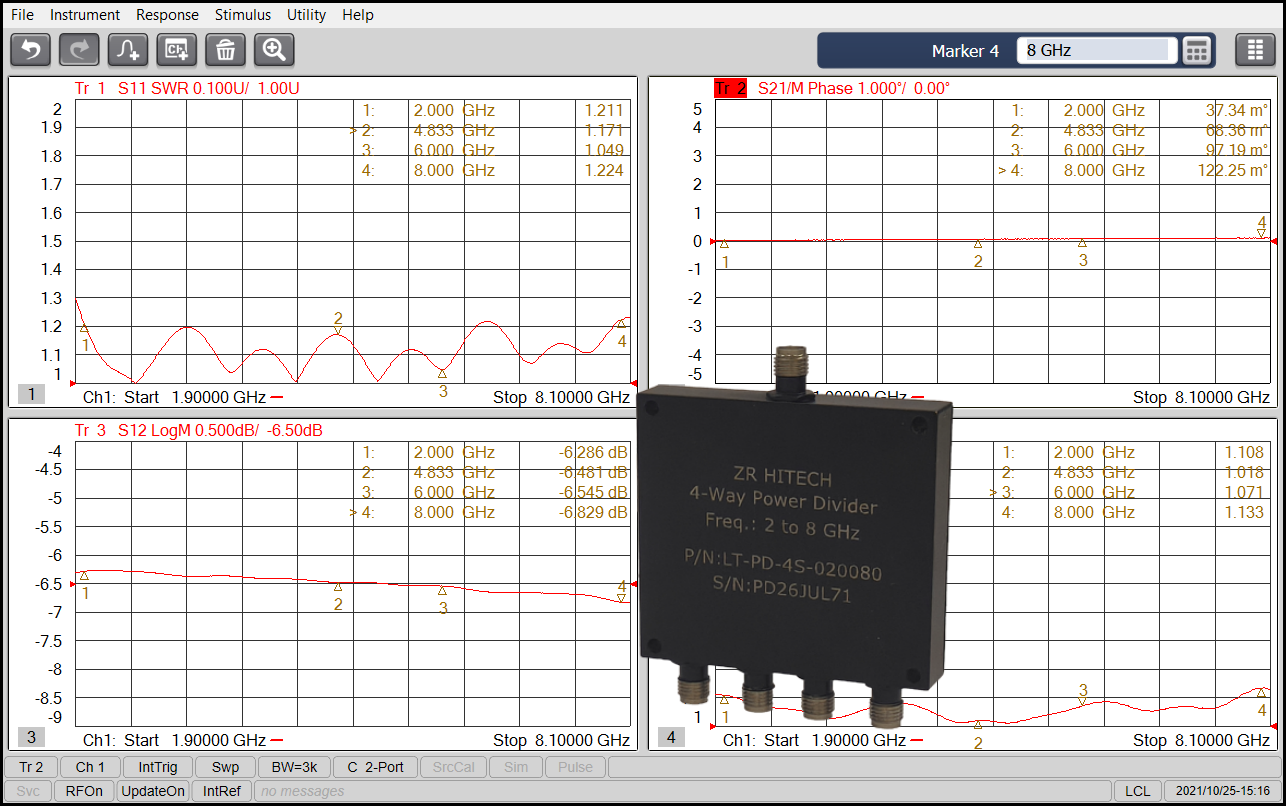
A power divider has a splitting loss of 3dB, and a four-way divider is 6dB. In addition to the splitting loss, real devices also absorb a bit more due to conductors, dielectric, matching, etc. This is called ‘extra loss,’ usually around 0.2-0.5dB. So a two-way divider with a nominal insertion loss of 3.3dB isn’t performing poorly; it’s just 3dB due to physical law plus 0.3dB device loss.
When choosing a model, the smaller the ‘extra loss,’ the better, but it’s meaningless to just compare the nominal insertion loss without looking at this.
Isolation: The Key Difference Between a Power Divider and a T-joint
The isolation between the two output ports determines whether the signal will leak from one port to the other.
Suppose you use a 2-way power splitter to supply the local oscillator to two mixers. If the isolation is only 10dB, the LO leakage from one mixer will sneak into the other mixer, causing the two channels to interfere with each other. With an isolation of over 30dB, this kind of crosstalk can basically be ignored.
Narrowband power dividers can reach an isolation of 25-30dB, while broadband ones are usually around 18-22dB. When choosing, check the isolation curve in the datasheet to make sure it’s not below your system’s tolerance across the whole operating frequency range.
Amplitude Balance: You Can Check These Two Numbers to See the Channel Consistency
Amplitude balance is the power difference between two outputs, measured in dB. Phase balance is how many degrees the phase difference deviates from 0°.
In a single communication link, a 0.5dB amplitude difference and a 5° phase difference might not matter. But for a phased array feed network, the amplitude and phase errors at each stage will accumulate, eventually affecting the beam direction and sidelobe levels. For phased array power dividers, the amplitude balance is usually required to be ≤0.3dB and the phase ≤3°.
When cascading multiple stages, errors accumulate. A single power splitter has ±0.2dB, and after four stages cascaded, the worst-case could be ±0.8dB. When designing the system, you need to account for the cumulative cascade error in the link budget.
Power Capacity: The First Threshold of The Transmit Chain
The small signal meter used in the receiving link is equipped with a power divider, and the internal isolation resistor usually has a rated power of only a few tens of mW. If used in the transmission link for power distribution or synthesis, tens of watts are injected, the resistor burns out, and the power splitter becomes an open circuit.
For the transmit link power divider, first look at the rated power. High-power models use resistors with higher rated power inside, or adopt a cavity structure without isolated resistors. The current and heat dissipation capabilities are totally different.
Port Handling: Don’t leave unused ports hanging
Leaving an output port of a power divider unused and just hanging it in the air is a common mistake. A floating port reflects all the signals, which then bounce back into the network, messing up the VSWR and insertion loss of the whole divider. Any unused output has to be terminated with a 50Ω load. If there are multiple power dividers cascaded in a link, every unused port needs to be terminated.
Power dividers sit at key points in a link, handling either distribution or combining. Extra insertion loss, isolation, amplitude and phase consistency, power capacity, and port termination—each one has to be managed. Pick the right one, and the link is seamless; pick wrong, and the cost of rework is way higher than the divider itself.