Newsroom
Power Divider: Research and Application in Low-Frequency 5G Network Construction
Introduction
Background
1. High construction and maintenance costs
5G equipment has high costs, high power consumption, and short coverage distance, which significantly increases the cost pressure for operators in terms of construction costs, operation and maintenance costs, and the scale of base stations. The introduction of low-frequency 5G has to some extent reduced the density of base stations and the scale of construction. On this basis, it is very important to continue in-depth research and exploration of construction methods that reduce costs.
2. Low RRU utilization
5G is indeed more advanced than 4G in various aspects, with significant improvements in data carrying capacity and device power. The utilization rate of the RRU is a key factor affecting energy consumption. If there is no high-volume data demand, the RRU remains in a low-utilization state for a long time, which is a waste of existing resources.
3. Low coverage requirements
With the full coverage of the 5G network, in many scenarios the 5G traffic offload ratio is low and data traffic is light. Although energy consumption can be controlled by enabling software and hardware switches such as dynamic on/off, the actual RRU resources have already been wasted or need to be repaired by dismantling lines to fill blind spots, which also incurs costs for implementation. By considering the current situation of the 4G network and combining it with planned resources, specific scenarios can be selected, such as suburban-urban junctions, where the traffic volume is low, residential areas are not dense, and after all, being in the urban area, the distance between stations is not large and the sites are relatively dense. Such scenarios have relatively low requirements for 5G coverage distance and capacity.
4. Introduction of the power divider
In mobile communication networks, power dividers are widely used in indoor coverage networks. Their advantage is cost saving, while the disadvantage is signal loss. Since macrocell coverage distance is an important metric for wireless networks, power dividers are generally not used to build stations by sacrificing coverage distance to save costs. However, with the improvement of power divider performance and the development of networks, combined with certain specific scenarios, the introduction of power dividers can be considered to save on construction and maintenance investments.
The Application of Power Dividers in Low-Frequency 5G Networks
1. Refine scenarios and combine with existing 4G network data
Currently, operators are building 5G base stations, and the vast majority are being constructed on the existing 4G physical sites. The specific selection principles are as follows:
(1) First, select planned 5G sites at the urban-rural junctions, towns, and rural areas;
(2) Analyze the site spacing that meets requirement (1), with a site spacing not greater than 1.5 km;
(3) Conduct traffic analysis within 1.5 km around the sites that meet requirement (2), and select sites where both daily average traffic and peak traffic are below the threshold value. (The threshold value is determined by the municipal network optimization team);
(4) Analyze the selected sites to determine whether to use a one-to-two or one-to-three construction method, and for the one-to-two method, determine which two sectors will use the power splitter.
2. Specific Implementation
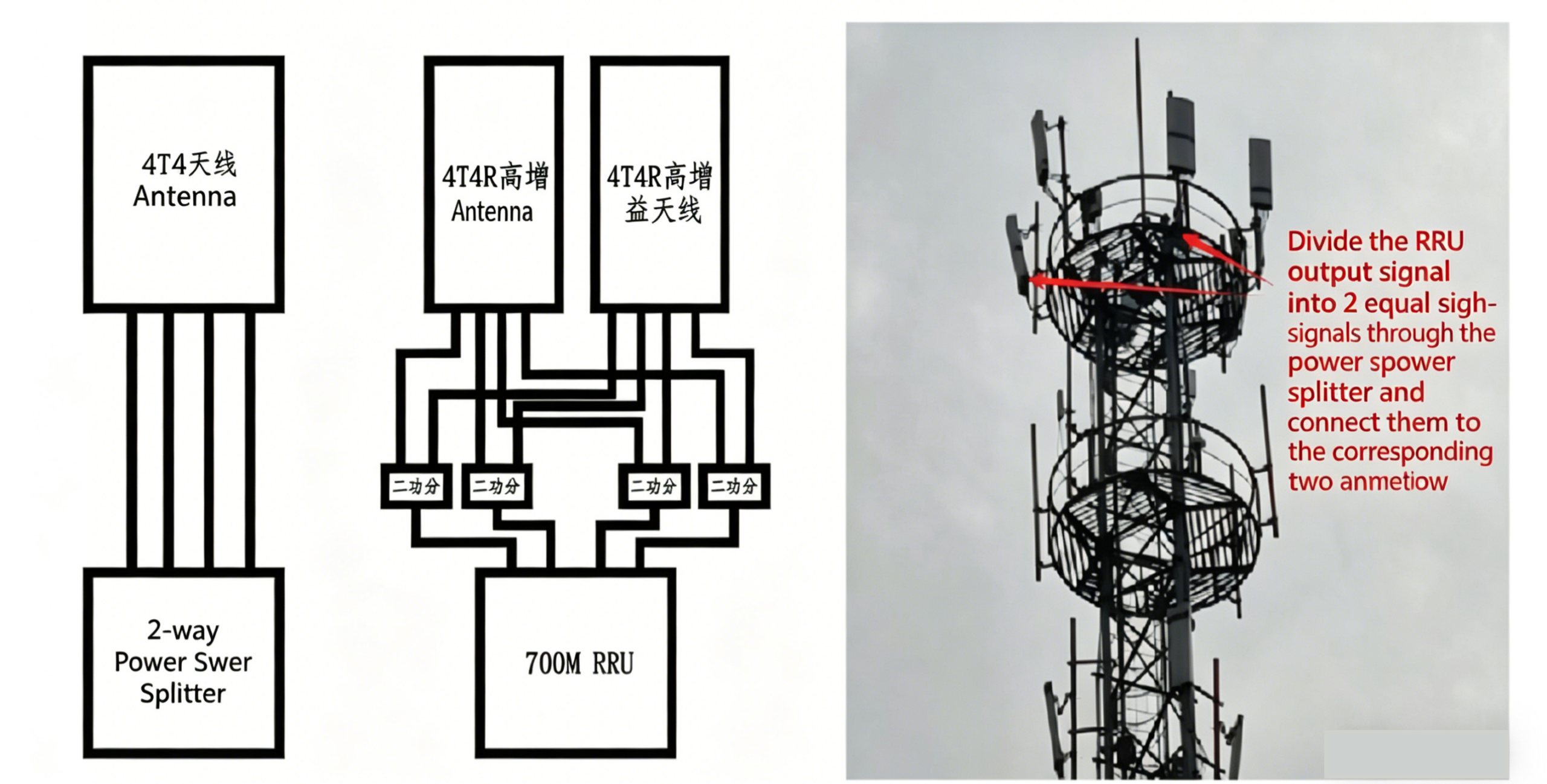
The introduction of a power splitter physically divides the original RRU input signal into 2 or 3 output signals, reducing the number of RRUs and fully utilizing the performance of each RRU. The connection diagram of the 700M power splitter is shown in Figure 1.
Conclusion
Liberate thinking is essential amid the rapid development of communication technology, as we should no longer rigidly follow conventional mindsets; some technical solutions that were not applicable in the 2G, 3G and 4G eras can be widely adopted in low-frequency 5G network construction, and the power divider solution promoted by ZR Hi-tech fits well with current industry trends while helping fulfill national and corporate goals of cost reduction and efficiency improvement. Meanwhile, through multi-dimensional feasibility comparison and analysis from technical performance, economic applicability and scalability perspectives, together with pilot test verification, it can be confirmed that the power divider deployment scheme proposed by ZR Hi-tech is technically feasible, economically viable and practically usable for actual network engineering.