Newsroom
Optimizing RF Performance: The Role of GaN Power Amplifier in High-Power Wireless and Radar Systems
Power Amplifier Drive Antenna
In contrast to the challenging signal capture of LNAs, power amplifier extract relatively strong signals from circuits with high SNR and must be used to boost signal power. All common factors related to the signal are known, such as amplitude, modulation, waveform, and duty cycle. This is the known signal/known noise quadrant in signal processing diagrams, and it is the easiest to handle.
The primary parameter of a power amplifier (PA) is its output power at the target frequency. Typical PA gain ranges from +10 to +30 dB. Energy efficiency is another key parameter, second only to gain. However, evaluating efficiency can be complex. It depends on factors such as modulation, duty cycle, signal models, and allowable distortion. In general, PA efficiency ranges from 30% to 80%, depending on the application and design conditions. Linearity is also an important parameter for PAs. It is typically evaluated using the IP3 (third-order intercept point), similar to LNAs.
Many power amplifiers (PAs) use low-power CMOS technology. These devices typically support output levels of about 1 to 5 W. In recent years, other technologies have matured and become widely adopted. This is especially true for higher-power applications. At higher power levels, energy efficiency becomes a critical factor. It directly impacts battery life and heat dissipation. For applications requiring several watts or more, GaN power amplifiers offer clear advantages. They provide higher efficiency at higher power levels and frequencies, typically around 1 GHz. In addition, GaN PAs are highly cost-competitive when considering both energy efficiency and power dissipation.
High-Power GaN PA Example: CGHV14800F Performance, Packaging, and Thermal Derating
The Cree/Wolfspeed CGHV14800F is a GaN-based power amplifier. It operates from 1200 to 1400 MHz and delivers up to 800 W of output power. It is based on HEMT technology. The device offers a strong combination of efficiency, gain, and bandwidth. This makes it well-suited for pulsed L-band radar applications. Typical use cases include air traffic control (ATC), weather radar, missile defense, and target tracking systems. The device operates from a 50 V power supply. It provides a typical energy conversion efficiency of 50% or higher. The amplifier is packaged in a 10 × 20 mm ceramic housing. It also features a metal flange for effective heat dissipation.
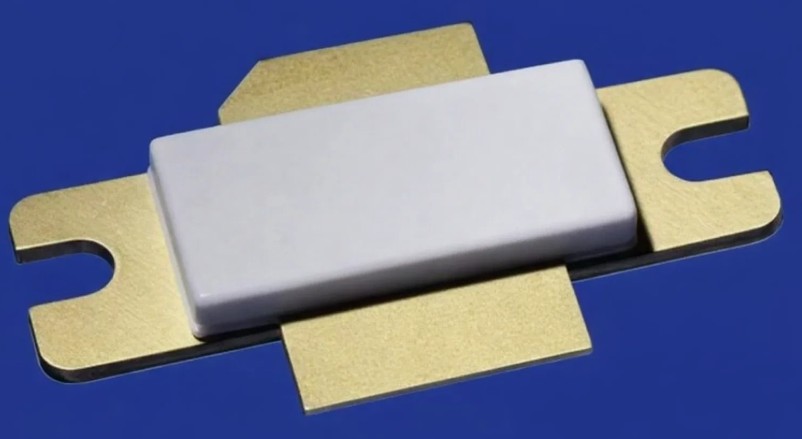
The CGHV14800F operates from a 50 V supply, typically providing 14 dB of power gain and an energy conversion efficiency > 65%. As with LNAs, evaluation circuitry and reference designs are crucial.
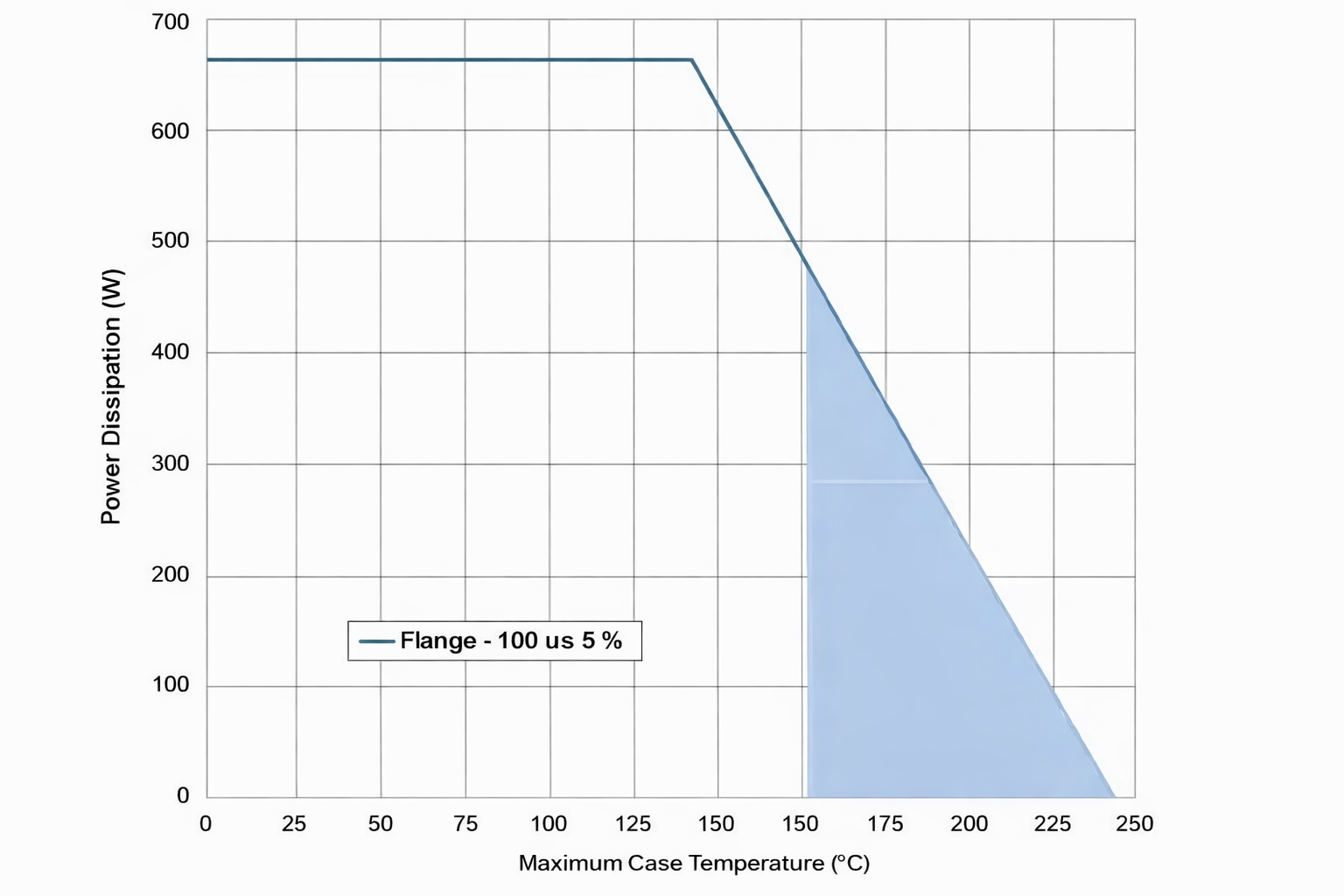
Equally important among the many specification sheets and performance curves is the power dissipation derating curve (Figure 9). This curve shows the relationship between the available power output rating and the case temperature, indicating that the maximum permissible power is constant at 115°C and then linearly decreases to the maximum rating at 150°C.
GaN PA Example: NPT1007 Performance, SWR Robustness, and Load-Pull Analysis
MACOM also offers GaN-based power amplifiers, such as the NPT1007 GaN transistor (Figure 10). Its DC to 1200 MHz frequency span is suitable for both broadband and narrowband RF applications. The device typically operates from a single supply between 14 and 28 V and provides a small-signal gain of 18 dB at 900 MHz. The design is intended to tolerate a 10:1 SWR (Standing Wave Ratio) mismatch without device degradation.
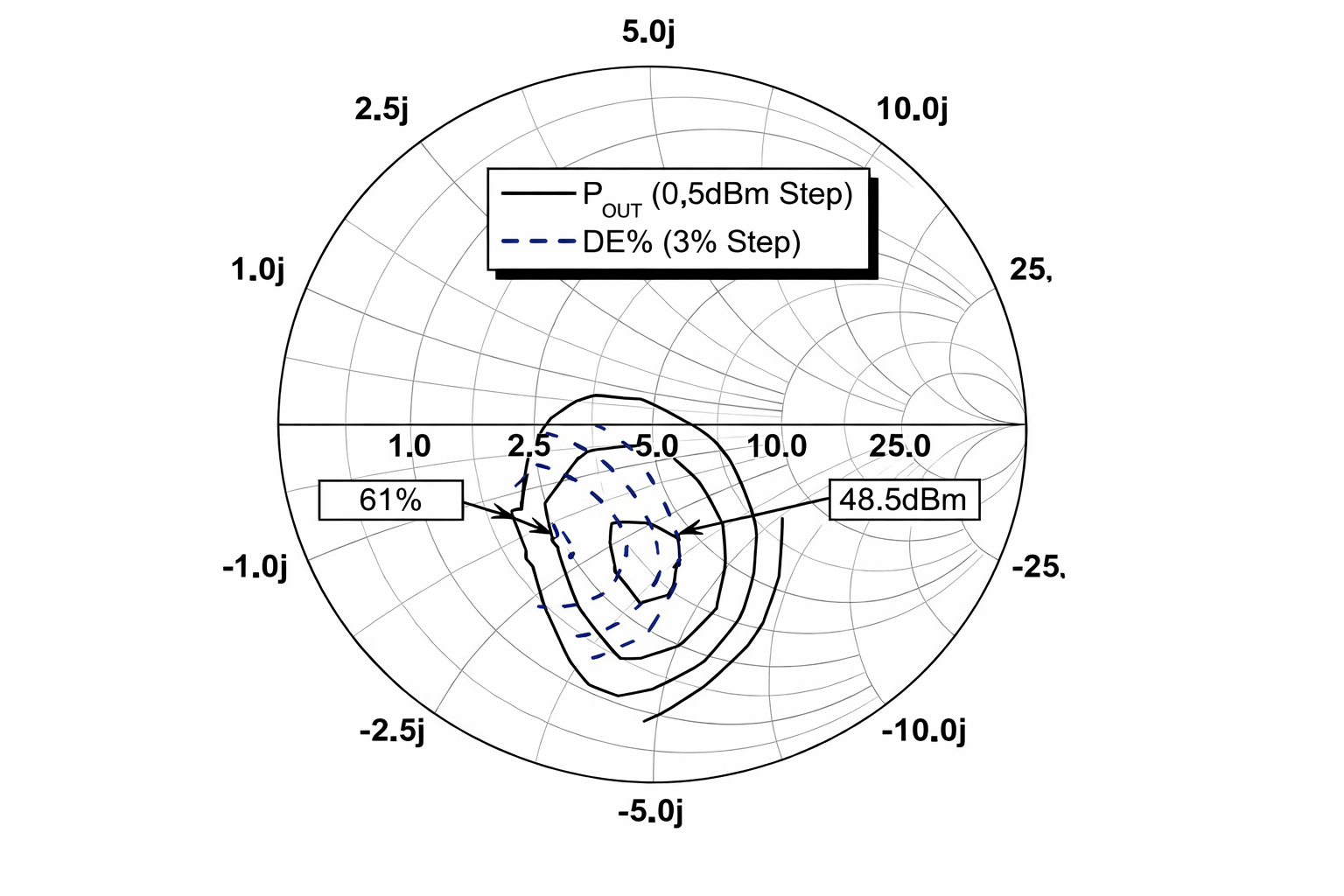
In addition to displaying baseline performance graphs at 500, 900, and 1200 MHz, the NPT1007 supports various “load stretch” graphs to assist circuit and system designers striving to ensure stable products. Load stretch testing is performed using paired signal sources and a signal analyzer (spectrum analyzer, power meter, or vector receiver). This test requires observing the impedance change of the device under test (DUT) to evaluate the PA’s performance (including factors such as output power, gain, and efficiency), as all relevant component values can change due to temperature variations or variations within the tolerance band around their nominal values.
Impedance Matching, Packaging, and Thermal Management in High-Power PA Design
Regardless of the PA (Power Amplifier) process used, the output impedance of the device must be fully characterized by the supplier so that the designer can correctly match the device to the antenna, achieving maximum power transfer and maintaining consistent SWR (Surface Reflectance). The matching circuit mainly consists of capacitors and inductors and can be implemented as discrete components or fabricated as part of a printed circuit board or even the product package. Its design must also maintain the PA power level. Again, the use of tools such as the Smith chart is key to understanding and performing the necessary impedance matching.
Given the small chip size and high power levels of power amplifiers (PAs), packaging is a critical issue. As mentioned earlier, many PAs utilize wide thermal lead-out and flange support, along with a heatsink beneath the package, as a path to the printed circuit board copper. At higher power levels (approximately above 5 to 10 W), PAs may have copper caps, allowing heatsinks to be mounted on top, and may require fans or other advanced cooling technologies.
The power ratings and small size associated with GaN PAs mean that thermal environment modeling is crucial. Simply keeping the PA itself within permissible limits or junction temperature ranges is insufficient. Heat dissipated from the PA must not cause problems for the circuitry or other parts of the system. The entire thermal path must be considered and addressed.
Conclusion
RF-based systems—from smartphones to VSAT terminals and phased-array radar—continue to push the performance boundaries of both LNAs and PAs. To meet these demands, the industry is rapidly transitioning from traditional silicon processes to advanced technologies such as GaAs and GaN, enabling higher efficiency, wider bandwidth, and more compact designs.
However, fully leveraging these innovations requires a solid understanding of RF fundamentals, including gain, noise, linearity, thermal management, and impedance matching. Only with the right design approach can engineers maximize system performance and reliability.
As a trusted RF component manufacturer, ZR Hi-Tech is committed to delivering high-performance solutions across amplifiers, filters, and RF modules. Our products are designed to support next-generation wireless, satellite communication, and radar systems.
Contact ZR Hi-Tech today to discover how our RF solutions can enhance your next project.