Newsroom
The Ultimate Guide to RF Power Amplifiers: Principles, Types, Applications, and Design Challenges
In modern wireless communication systems, signals must travel across vast distances while maintaining reliability and integrity. From cellular networks and satellite communication to radar and defense systems, radio-frequency (RF) technology enables information to move through the air using electromagnetic waves.
One critical component makes long-distance wireless transmission possible: the RF Power Amplifier (PA).
RF power amplifiers increase the power of radio-frequency signals so they can drive antennas and propagate through space effectively. Without these amplifiers, most wireless systems would struggle to transmit signals over practical distances.
This comprehensive guide explores everything engineers and RF enthusiasts need to know about RF power amplifiers, including their operating principles, amplifier classes, key performance metrics, applications, and design challenges.
1. What Is an RF Power Amplifier?
An RF power amplifier is an electronic device that increases the power of a radio-frequency signal before transmission through an antenna. It converts a low-power RF input signal into a high-power output signal suitable for wireless transmission.
In a typical RF transmitter architecture, the power amplifier is placed at the final stage of the signal chain, right before the antenna.
A simplified RF transmitter chain includes:
Signal Source → Modulator → Driver Amplifier → Power Amplifier → Antenna
The amplifier ensures the signal has enough strength to travel long distances and overcome losses caused by atmospheric attenuation, obstacles, and interference.
RF power amplifiers are essential components in many wireless technologies, including:
-
Cellular base stations
-
Satellite communication systems
-
Radar transmitters
-
Wireless networking equipment
-
Broadcasting infrastructure
Without adequate amplification, signals generated by oscillators or modulators would be too weak to propagate effectively.
2. Basic Operating Principles of RF Power Amplifiers
At the heart of every RF power amplifier is an active device, typically a transistor such as:
-
LDMOS
-
GaAs
-
GaN
-
CMOS
These devices amplify signals by controlling the flow of current using a small input signal.
Signal Amplification Mechanism
When an RF input signal is applied to the amplifier:
-
The input signal modulates the transistor bias.
-
The transistor draws energy from the DC power supply.
-
The amplifier converts DC power into RF output power.
The result is a larger RF signal at the output while preserving the waveform characteristics of the input signal.
To achieve efficient power transfer, amplifiers must also include impedance matching networks, which ensure that maximum power is delivered from the amplifier to the antenna.
3. Key Performance Metrics of RF Power Amplifiers
When evaluating RF power amplifiers, engineers focus on several critical specifications.
Output Power
Output power represents the maximum RF power that the amplifier can deliver to the load.
It is typically expressed in:
-
Watts
-
dBm
Higher output power allows signals to travel further and improves communication coverage.
Gain
Gain represents how much the amplifier increases the signal power.
Gain is expressed in decibels (dB) and calculated as:
Gain (dB) = 10 log (Pout / Pin)
Most RF power amplifiers provide gain values between 10 dB and 50 dB, depending on the application.
Power Added Efficiency (PAE)
Efficiency is one of the most important parameters in RF power amplifier design.
The most commonly used metric is Power Added Efficiency (PAE):
PAE = (Pout − Pin) / PDC
where:
-
Pout = RF output power
-
Pin = RF input power
-
PDC = DC supply power
High PAE reduces power consumption, improves battery life in mobile systems, and minimizes heat generation.
Linearity
Linearity describes how accurately the amplifier reproduces the input signal.
Modern communication systems use complex modulation schemes such as:
-
OFDM
-
QAM
-
LTE modulation
These signals require highly linear amplification to prevent distortion and interference.
Bandwidth
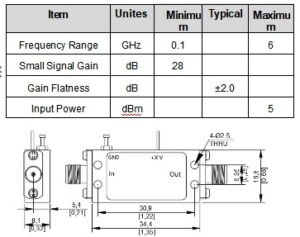
Bandwidth determines the frequency range over which the amplifier performs effectively.
Wideband RF power amplifiers are increasingly important for applications such as:
-
5G communication
-
satellite systems
-
broadband wireless networks.
4. Classes of RF Power Amplifiers
RF power amplifiers are commonly categorized by their operating class, which describes how the transistor conducts current during a signal cycle.
Amplifier classes represent a trade-off between efficiency and linearity.
Class A Amplifier
Class A amplifiers conduct current throughout the entire signal cycle (360° conduction).
Advantages:
-
Excellent linearity
-
Minimal signal distortion
Disadvantages:
-
Very low efficiency
-
High power dissipation
Typical efficiency is around 20–35%.
Class A amplifiers are commonly used in:
-
driver stages
-
low-power RF circuits
Class B Amplifier
Class B amplifiers conduct for half of the signal cycle (180°).
Advantages:
-
Higher efficiency than Class A
Disadvantages:
-
Crossover distortion
Class AB Amplifier
Class AB amplifiers operate between Class A and Class B.
They conduct slightly more than half of the signal cycle and provide a good balance between linearity and efficiency.
Because of this balance, Class AB amplifiers are widely used in wireless communication transmitters.
Class C Amplifier
Class C amplifiers conduct for less than half of the signal cycle.
Advantages:
-
Very high efficiency
Disadvantages:
-
Significant distortion
Class C amplifiers are commonly used in high-power narrowband systems such as radar transmitters.
Switching Amplifiers (Class D, E, F)
Switch-mode amplifiers operate the transistor as a switch rather than in a linear region.
Advantages:
-
Extremely high efficiency
-
Reduced power dissipation
Class E and Class F amplifiers can theoretically achieve efficiencies greater than 80–90% in some designs.
These architectures are often used in specialized RF systems.

5. Semiconductor Technologies for RF Power Amplifiers
Advances in semiconductor materials have significantly improved RF power amplifier performance.
LDMOS
LDMOS technology is widely used in cellular base station amplifiers due to its reliability and cost-effectiveness.
Gallium Nitride (GaN)
GaN devices offer several advantages:
-
High power density
-
High breakdown voltage
-
Excellent thermal performance
GaN amplifiers are widely used in:
-
radar systems
-
satellite communication
-
defense applications
Gallium Arsenide (GaAs)
GaAs amplifiers are commonly used in microwave and millimeter-wave circuits due to their high electron mobility.
6. Major Applications of RF Power Amplifiers
RF power amplifiers play a critical role in many industries.
Cellular Communication
Modern mobile networks rely heavily on RF power amplifiers to transmit signals between base stations and mobile devices.
These amplifiers support technologies such as:
-
4G LTE
-
5G networks
-
wireless broadband.
Satellite Communication
Satellite communication requires high-power amplification to transmit signals across thousands of kilometers between ground stations and orbiting satellites.
Applications include:
-
satellite internet
-
satellite TV
-
navigation systems.
Radar Systems
Radar systems use RF power amplifiers to generate high-power microwave pulses used for object detection.
The performance of radar systems depends heavily on amplifier power and efficiency.
Broadcasting Systems
RF power amplifiers enable radio and television transmitters to broadcast signals over large geographic areas.
Electronic Warfare and Defense
In military applications, RF power amplifiers support:
-
radar jamming
-
secure communications
-
signal intelligence systems.
Test and Measurement
High-power amplifiers are also used in electromagnetic compatibility (EMC) testing, where strong RF fields are required to test electronic equipment performance.

7. Design Challenges in RF Power Amplifiers
Despite their importance, designing RF power amplifiers presents several technical challenges.
Efficiency vs Linearity Trade-Off
Increasing amplifier efficiency often reduces linearity.
Engineers must carefully balance these competing requirements when designing amplifiers for modern communication systems.
Heat Dissipation
High-power operation generates significant heat.
Thermal management techniques include:
-
heat sinks
-
advanced packaging
-
improved semiconductor materials.
Impedance Matching
Proper impedance matching is required to ensure maximum power transfer between amplifier stages and antennas.
Matching networks are typically designed using tools such as Smith charts and electromagnetic simulation software.
Stability
RF amplifiers can oscillate if not properly designed.
Engineers must ensure stability across all operating frequencies.
Wideband Design
Modern wireless systems often require amplifiers capable of operating across wide frequency ranges without performance degradation.
8. Future Trends in RF Power Amplifier Technology
As wireless communication technologies evolve, RF power amplifiers continue to advance.
Key trends include:
GaN Dominance
GaN technology is rapidly becoming the preferred solution for high-power RF systems due to its superior efficiency and thermal performance.
Digital Predistortion (DPD)
DPD techniques improve amplifier linearity by compensating for distortion in real time.
Envelope Tracking
Envelope tracking improves amplifier efficiency by dynamically adjusting the supply voltage based on signal amplitude.
Integration into RF Modules
Modern RF systems increasingly integrate amplifiers with filters, switches, and LNAs into compact RF front-end modules.
9. RF Amplifier Solutions from ZR Hi-Tech
As wireless systems become more advanced, the demand for reliable RF components continues to grow.
ZR Hi-Tech specializes in the development and manufacturing of high-performance RF solutions, including:
-
RF Power Amplifiers
-
Low Noise Amplifiers
-
Microwave modules
-
RF components for communication and defense systems
ZR Hi-Tech products are designed to provide stable gain, high efficiency, and reliable performance across wide frequency ranges, supporting applications in telecommunications, aerospace, radar, and research laboratories.
Conclusion
RF power amplifiers are fundamental building blocks of modern wireless communication systems.
By converting low-power RF signals into high-power signals suitable for transmission, ZR Hi-tech amplifiers enable technologies such as cellular communication, satellite networks, radar systems, and broadcasting.
Understanding the principles, amplifier classes, design challenges, and applications of RF power amplifiers allows engineers to design more efficient and reliable wireless systems.
As communication technologies continue evolving toward 5G, satellite internet, and future 6G networks, RF power amplifiers will remain a key technology driving the future of global connectivity.