Newsroom
Power Amplifier vs Low Noise Amplifier: Key Differences, Advantages, and Applications
In RF and microwave communication systems, amplifiers play a crucial role in ensuring signal strength and quality. Two of the most commonly used amplifier types are the Power Amplifier (PA) and the Low Noise Amplifier (LNA).
Although both devices amplify RF signals, they serve very different purposes in a communication chain. Understanding the difference between PA and LNA is essential for RF engineers when designing systems such as wireless communication equipment, radar systems, satellite communication, and IoT devices.
In this article, we will explore what a power amplifier is, what a low noise amplifier is, their key differences, advantages, and typical applications.
What is a Power Amplifier (PA)?
A Power Amplifier (PA) is an electronic device designed to increase the power level of a radio frequency signal before it is transmitted through an antenna. It is typically located at the final stage of the transmitter chain.
The main function of a PA is to boost the signal power to a level that can be effectively transmitted over long distances.
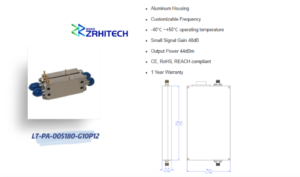
Key Characteristics of Power Amplifiers
Typical parameters used to evaluate RF power amplifiers include:
-
Output Power
-
Power Gain
-
Efficiency
-
Linearity
-
P1dB Compression Point
Because PAs handle large signals, they must be designed to withstand high voltage, high current, and thermal stress.
Typical Applications of PA
Power amplifiers are widely used in:
-
Wireless communication systems
-
Radar transmitters
-
Satellite communication equipment
-
Base stations
-
Broadcasting transmitters
-
Aerospace and defense systems
For RF systems requiring strong transmission capability, high power RF amplifiers are critical components.
What is a Low Noise Amplifier (LNA)?
A Low Noise Amplifier (LNA) is designed to amplify very weak signals while introducing minimal additional noise. LNAs are typically located at the front end of the receiver, immediately after the antenna.
Since the received signal is often extremely weak, preserving signal quality at this stage is crucial.
Key Characteristics of Low Noise Amplifiers
Important performance parameters of LNAs include:
-
Noise Figure (NF)
-
Gain
-
Linearity
-
Input/Output Return Loss
-
Stability
Among these metrics, the noise figure is the most critical. A lower noise figure allows the receiver to maintain a higher signal-to-noise ratio (SNR).
Typical Applications of LNA
Low noise amplifiers are commonly used in:
-
Satellite receivers
-
GNSS systems
-
Wireless receivers
-
Radio astronomy
-
Radar receivers
-
IoT devices
In these systems, low noise RF amplifiers are essential for detecting weak signals with high accuracy.
Key Differences Between PA and LNA
Although both devices amplify signals, their roles in RF systems are fundamentally different.
| Feature | Power Amplifier (PA) | Low Noise Amplifier (LNA) |
|---|---|---|
| System Position | Transmitter output stage | Receiver front end |
| Main Purpose | Increase signal power for transmission | Amplify weak signals with minimal noise |
| Key Parameter | Output power & efficiency | Noise figure |
| Signal Strength | Handles large signals | Handles extremely weak signals |
| Power Consumption | High | Low |
| Design Focus | Thermal management and efficiency | Low noise performance |
In simple terms:
PA focuses on power, while LNA focuses on signal quality.
Advantages and Limitations of Power Amplifiers
Advantages
-
Provides strong signal transmission capability
-
Enables long-distance communication
-
High output power for demanding RF systems
Limitations
-
Higher power consumption
-
Generates more heat
-
Requires careful thermal management
Advantages and Limitations of Low Noise Amplifiers
Advantages
-
Improves receiver sensitivity
-
Maintains signal integrity
-
Enhances system signal-to-noise ratio
Limitations
-
Limited output power capability
-
Sensitive to impedance matching and stability issues
How PA and LNA Work Together in RF Systems
In a typical RF communication system:
-
The LNA amplifies weak signals received from the antenna.
-
The signal is processed through filters and mixers.
-
The PA boosts the signal before transmission.
Together, these components ensure both strong transmission and accurate reception, which is essential for reliable communication systems.
Conclusion
Both Power Amplifiers (PA) and Low Noise Amplifiers (LNA) are fundamental components in RF and microwave systems, but they serve different purposes.
-
PA increases signal power for transmission.
-
LNA amplifies weak signals while preserving signal quality.
Understanding the difference between PA and LNA helps engineers design more efficient and reliable RF systems.
At ZR Hi-Tech, we specialize in the development and manufacturing of high-performance RF components, including Power Amplifiers and Low Noise Amplifiers, supporting applications in wireless communication, radar, satellite systems, and advanced RF solutions.
If you are looking for reliable RF amplifier solutions, feel free to contact our team for more technical information.