Newsroom
High Power RF Amplifier Module Market: Size, Trends, Key Players, and Buying Insights
The High Power RF Amplifier Module Market is a dynamic sector at the intersection of advanced telecommunications, defense technologies, and industrial applications. These modules are essential for boosting radio frequency signals to high power levels, enabling reliable transmission over long distances or through challenging environments.
As demand for faster data rates, enhanced connectivity, and robust signal integrity grows, the market is witnessing significant expansion. This article delves into the key aspects of the High Power RF Amplifier Module Market, providing buyers with in-depth analysis to inform procurement decisions.
What Is Driving the Growth of the High Power RF Amplifier Module Market?
Several factors are propelling the High Power RF Amplifier Module Market forward. Primarily, the global rollout of 5G networks is a major driver. 5G requires amplifiers capable of handling higher frequencies and wider bandwidths to support ultra-low latency and massive data throughput. For instance, base stations and small cells in 5G infrastructure rely on these modules to amplify signals in the sub-6 GHz and mmWave bands, ensuring coverage in urban and rural areas alike.
Defense and aerospace sectors also contribute significantly. Modern military systems, including radar, electronic warfare, and satellite communications, demand high-power amplification for secure, long-range operations. Governments worldwide are investing heavily in upgrading defense infrastructure, with the U.S. Department of Defense allocating billions for advanced RF technologies to counter emerging threats.
Additionally, the proliferation of IoT devices and wireless communication in industrial settings fuels growth. Applications in smart manufacturing, such as remote monitoring and automation, require reliable RF amplification to maintain signal strength amid interference. Advancements in semiconductor materials, like Gallium Nitride (GaN), enhance efficiency and power density, making these modules more appealing for energy-conscious applications.
Economic factors play a role too. Post-pandemic recovery has accelerated digital transformation, increasing demand for wireless infrastructure. However, supply chain disruptions from geopolitical tensions have highlighted the need for resilient manufacturing, pushing companies to diversify sourcing.
Market Size, Growth Rate, and Forecast Outlook
The High Power RF Amplifier Module Market is poised for steady expansion. According to recent analyses, the market was valued at approximately USD 8.2 billion in 2022 and is projected to reach around USD 15 billion by 2031, growing at a compound annual growth rate (CAGR) of about 6.8%. Some forecasts suggest even higher growth, with a CAGR of 10.3% from 2026 to 2032, potentially hitting USD 16.34 billion.
This growth is segmented regionally, with North America leading due to strong investments in 5G and defense. The Asia-Pacific region follows closely, driven by rapid telecommunications infrastructure development in countries like China and India. Europe emphasizes sustainable technologies, contributing through advancements in GaN-based modules.
Forecasts indicate acceleration post-2025 as 6G research ramps up and satellite constellations expand. Challenges like raw material costs could temper growth, but opportunities in emerging markets, such as Africa and Latin America, offer new avenues.
Key Applications of High Power RF Amplifier Modules
High Power RF Amplifier Modules find diverse applications across industries. In telecommunications, they are integral to base stations, repeaters, and fixed wireless access systems. For 5G, RF power amplifier modules handling 100-150 Watts or more ensure signal propagation in dense urban environments.
In defense, these modules power radar systems for detection and tracking. Phased-array radars, for example, use band-specific amplifiers to operate in L-band (1-2 GHz) or S-band (2-4 GHz), providing high resolution and resistance to jamming.
Medical applications include MRI machines and particle accelerators, where precise amplification is crucial for imaging and therapy. Industrial uses span plasma generation, RF heating, and RF power amplifier testing equipment, such as in semiconductor fabrication.
Broadcasting relies on them for TV and radio transmission, while scientific research employs them in accelerators and telescopes. Emerging uses in electric vehicles (EVs) for wireless charging and autonomous systems highlight their versatility.
Technology Trends Shaping the Market
Technological innovations are reshaping the High Power RF Amplifier Module Market. The shift to solid-state amplifiers, particularly GaN-based ones, is prominent. GaN offers superior power efficiency (40-60% PAE), higher thermal stability, and operation at frequencies up to 40 GHz, outperforming traditional GaAs or LDMOS.
Miniaturization through integrated modules reduces size and weight, ideal for aerospace and portable defense systems. Advanced cooling technologies, like liquid-cooled or air-cooled designs, address heat dissipation in high-power scenarios.
Digital pre-distortion (DPD) techniques improve linearity, reducing distortion in multi-carrier environments. The integration of AI for adaptive amplification optimizes performance in real-time, enhancing reliability.
Sustainability trends favor energy-efficient RF power amplifier designs, with GaN on SiC or diamond substrates promising even better thermal management. Broadband amplifiers covering multiple frequency bands (e.g., low to very high frequency) are gaining traction for versatile applications.
High Power RF Amplifier Module Market Segmentation
The market segments by product type, output power, RF power amplifier classes of operation, frequency range, cooling technology, application, and end-use.
- By Product Type: Broadband RF power amplifier (wide frequency coverage) and Band-Specific (optimized for narrow bands like S-band).
- By Output Power: 10-50 Watts (low-end applications), 50-100 Watts, 100-150 Watts, and >150 Watts (high-power defense).
- By Class of Operation: Class A (high linearity), Class AB (balanced efficiency), and others like Class D RF power amplifier.
- By Frequency Range: Low (up to 1 GHz), Medium (1-10 GHz), High (10-30 GHz), Very High (>30 GHz).
- By Cooling Technology: Air-Cooled (cost-effective), Liquid-Cooled (high performance), Passive.
- By Application: Telecommunications (largest), Broadcasting, Medical, Industrial, Military.
- By End-Use: Consumer Electronics, Commercial, Defense (fastest-growing).
RF power amplifiers for wireless communication dominates end-use, holding the largest share due to 5G demand.
Competitive Landscape and Key Market Players
The High Power RF Amplifier Module Market is competitive, with established players investing in R&D for GaN innovations. Key companies include ZR Hi-Tech, Analog Devices, Inc., NXP Semiconductors N.V., Qorvo, Inc., Skyworks Solutions, Inc., Broadcom Inc., MACOM Technology Solutions, Infineon Technologies AG, Empower RF Systems, Inc., OPHIR RF, and Aethercomm Inc.
As an RF power amplifier manufacturer, ZR Hi-Tech provides reliable modules tailored for industrial and telecom needs, emphasizing efficiency and durability.
These firms focus on strategic partnerships and acquisitions to expand portfolios. For example, Qorvo excels in GaN for 5G and defense, while NXP emphasizes automotive integrations. Emerging players like RFHIC and Tomco Technologies target niche high-power applications.
Regional dynamics show North American dominance, with Asia-Pacific gaining through cost-effective manufacturing.
What Buyers Should Consider When Selecting a High Power RF Amplifier Module
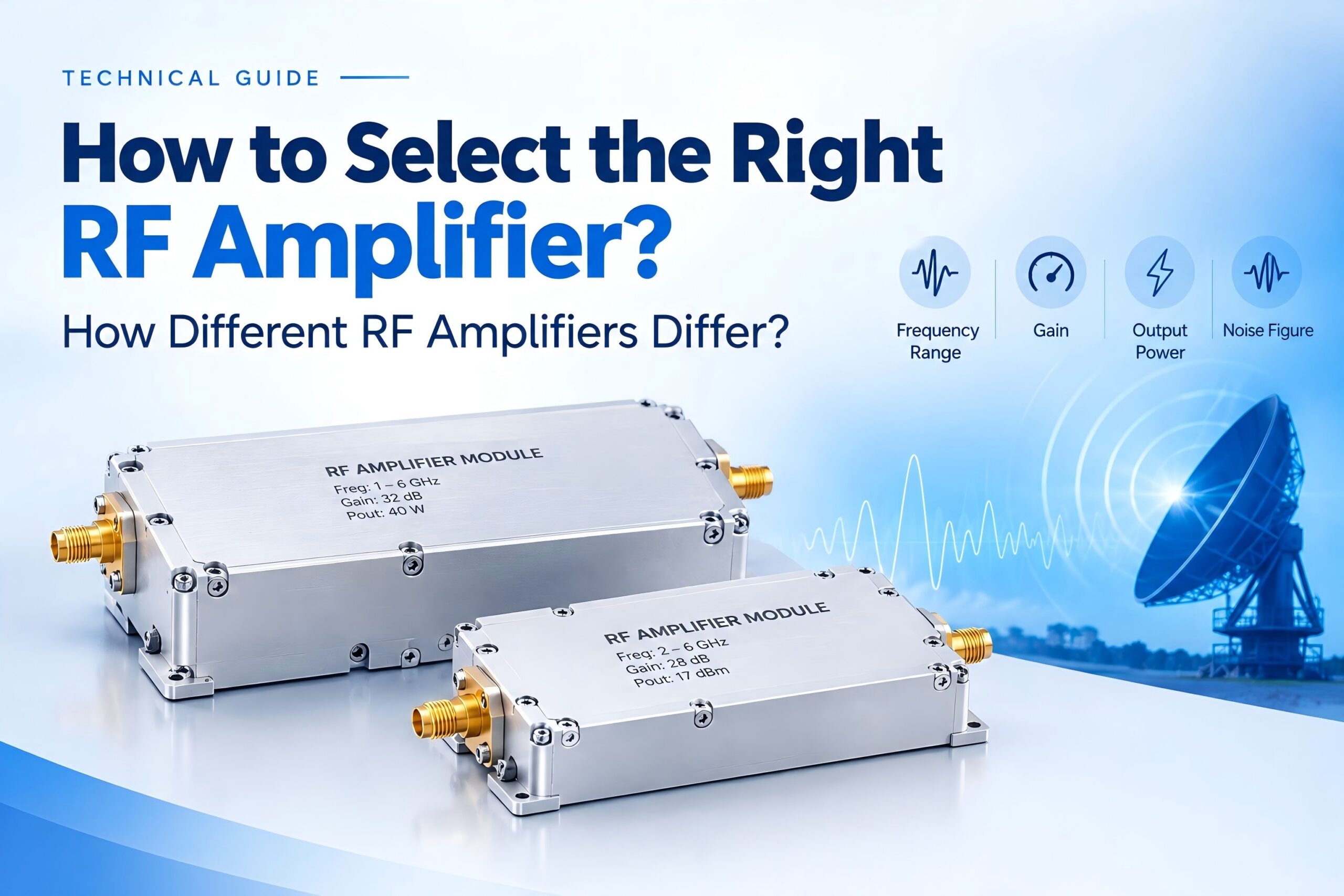
Buyers must evaluate several criteria for optimal selection. First, assess power requirements: Match output power (e.g., >150 Watts for radar) to application needs. Frequency range and bandwidth are critical; broadband RF power amplifier modules suit versatile uses, while band-specific offer better efficiency.
Efficiency and thermal management impact operational costs—look for GaN modules with PAE >50% and advanced cooling. Reliability metrics like MTBF (mean time between failures) ensure longevity in harsh environments. Compliance with standards (e.g., MIL-STD for defense) is essential.
Cost considerations include initial price versus lifecycle savings from energy efficiency. Vendor support, customization options, and supply chain stability mitigate risks. Finally, test for linearity and distortion using metrics like IMD3 (third-order intermodulation distortion) to ensure signal integrity.
Challenges and Risks in the High Power RF Amplifier Module Market
Despite growth, challenges persist. Thermal management is a primary issue; high-power operation generates significant heat, risking component failure without effective dissipation. Power efficiency remains lower in high-output modules, leading to higher energy costs and environmental concerns.
Supply chain vulnerabilities, exacerbated by semiconductor shortages and geopolitical issues, pose risks to availability. Regulatory hurdles, including spectrum allocation and export controls for defense tech, complicate market entry.
High manufacturing costs for GaN modules limit accessibility for smaller buyers. Interference mitigation in dense RF environments requires advanced designs, increasing complexity. Economic downturns could slow infrastructure investments, though defense spending often remains resilient.
Future Opportunities and Market Outlook
Looking ahead, the high power RF amplifier module market offers promising opportunities. 5G expansion and impending 6G development will drive demand for mmWave-capable modules.
Defense modernization, including hypersonic systems and space-based radar, presents growth avenues. Satellite mega-constellations like Starlink require scalable amplification for global coverage.
Emerging applications in EVs, autonomous vehicles, and smart cities will expand the market. Advancements in GaN on diamond could revolutionize efficiency, opening high-frequency niches. Sustainability initiatives favor green technologies, with opportunities in renewable energy monitoring.
Asia-Pacific’s infrastructure boom and Africa’s digital leapfrog offer untapped potential. By 2035, the market could exceed USD 20 billion, with a CAGR of 6-10%, contingent on innovation and geopolitical stability.
Conclusion
The High Power RF Amplifier Module Market stands as a cornerstone of modern connectivity and security. With robust growth driven by 5G, defense, and industrial advancements, buyers have access to increasingly efficient RF power amplifier technologies.
By considering key factors like power, efficiency, and reliability, procurement can align with strategic needs. As trends evolve toward GaN and integration, the market promises innovation and expansion, positioning it for a transformative decade ahead—contact us to learn how our solutions can power your next project.