Newsroom
Understanding VSWR in RF Systems: A Practical Guide to Standing Waves and Matching for Power Amplifi...
Introduction
In RF systems, impedance matching is critical for ensuring efficient signal transmission and system reliability. One of the most important parameters used to evaluate matching performance is the Voltage Standing Wave Ratio (VSWR).
VSWR provides a clear indication of how much signal is reflected in a transmission line, making it a key metric in RF design, testing, and system optimization. It is especially important in high-power applications such as power amplifiers, where poor matching can directly impact performance and device safety.
What Is a Standing Wave?
To understand VSWR, it is essential to first understand the concept of a standing wave.
A standing wave is formed when two waves with the same frequency and amplitude travel in opposite directions and interfere with each other. These waves combine to create a pattern where certain points, called nodes, have minimum amplitude, while others, called antinodes, have maximum amplitude.
Unlike traveling waves, where energy continuously propagates forward, standing waves do not transfer energy along the line. Instead, energy oscillates between nodes and antinodes. Although the waveform appears stationary, its instantaneous values still vary with time.
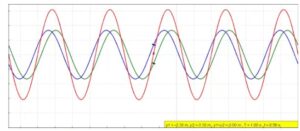
How Standing Waves Form in RF Transmission Lines
In practical RF systems, standing waves are caused by impedance mismatches.
When an RF signal travels along a transmission line and encounters a mismatch—such as at a connector, antenna, or load—part of the signal is reflected back toward the source. The superposition of the incident wave and the reflected wave creates a standing wave pattern.
This effect is particularly critical in systems containing power amplifiers, as reflected signals can travel back toward the amplifier output. Excessive reflection increases stress on the device and may reduce efficiency or even cause damage if not properly managed.
Definition of VSWR
VSWR is defined as the ratio of the maximum voltage to the minimum voltage along a transmission line:
- Maximum voltage → occurs at antinodes
- Minimum voltage → occurs at nodes
This ratio reflects the degree of mismatch in the system.
- VSWR = 1 → Perfect matching, no reflection
- VSWR > 1 → Partial reflection exists
- VSWR → ∞ → Total reflection
In real RF designs, achieving VSWR = 1 is not practical. However, lower VSWR values indicate better system performance, especially in power amplifier circuits where efficiency and reliability are critical.
Relationship Between VSWR and Reflection
In a transmission line, voltage and current are determined by the combination of incident and reflected waves. The behavior of the standing wave depends on the reflection coefficient:
- When the reflection coefficient is positive, voltage reaches a maximum (antinode), while current reaches a minimum (node).
- When the reflection coefficient is negative, voltage forms a node, and current forms an antinode.
At different points along the line, voltage and current values vary between these extremes, forming the standing wave pattern.
For power amplifiers, this relationship is especially important because reflected signals can increase voltage stress at the output stage, affecting linearity and reliability.
VSWR, Reflection Coefficient, and Return Loss
In RF engineering, VSWR is closely related to:
- Reflection Coefficient (Γ): Ratio of reflected to incident signal
- Return Loss (RL): Logarithmic (dB) representation of the reflection coefficient
These parameters describe the same physical behavior from different perspectives.
Return loss is often preferred in measurements because it provides a clearer view of system performance in dB terms, making it easier to evaluate impedance matching in RF systems, including power amplifier output stages.
Why VSWR Matters in RF Design
VSWR is a critical parameter because it directly impacts:
- Signal transmission efficiency
- Power loss due to reflection
- System stability and reliability
- Protection of RF components, especially power amplifiers
High VSWR means more reflected power, which can degrade system performance and increase the risk of damage to power amplifiers. Therefore, maintaining a low VSWR is essential to ensure efficient and safe operation.
VSWR and Power Amplifier Performance
In RF systems, power amplifiers are often the most sensitive components to impedance mismatch. When VSWR is high, reflected power travels back into the amplifier, which can cause:
- Reduced output efficiency
- Thermal stress
- Signal distortion
- Potential device failure
To avoid these issues, engineers aim to design systems with well-matched impedance across the transmission line. In many cases, additional RF components such as directional couplers are used to monitor forward and reflected power in real time, allowing protection circuits to respond quickly when VSWR increases.
Proper VSWR management not only protects the power amplifier but also ensures stable gain, linearity, and long-term reliability of the entire RF system.
Conclusion
VSWR is a fundamental parameter for evaluating impedance matching in RF systems. By understanding standing waves and their relationship with reflection coefficient and return loss, engineers can better design transmission lines and optimize system performance.
In practical applications, maintaining a low VSWR is especially important for protecting power amplifiers, improving power efficiency, and ensuring long-term system reliability. This makes VSWR a key consideration in modern RF system design.