Newsroom
RF Power Amplifier Industry Chain Situation
1. The Crown Jewel of RF Components
The RF power amplifier (PA), as a key component of the RF front-end transmit path, is mainly used to amplify the low-power RF signals produced by the modulation oscillator circuit to achieve sufficiently large RF output power, which can then be fed to the antenna for radiation. It is typically used to amplify the RF signal in the transmit channel.
Mobile phone RF front end: Once connected to a mobile network, any smartphone can easily browse social media, watch HD videos, download pictures, and shop online, which is entirely thanks to the evolution of the RF front end. Each network standard of a mobile phone (2G/3G/4G/WiFi/GPS) requires its own RF front-end module, acting as a bridge for the phone to communicate with the outside world—the more functions a phone has, the greater its value.
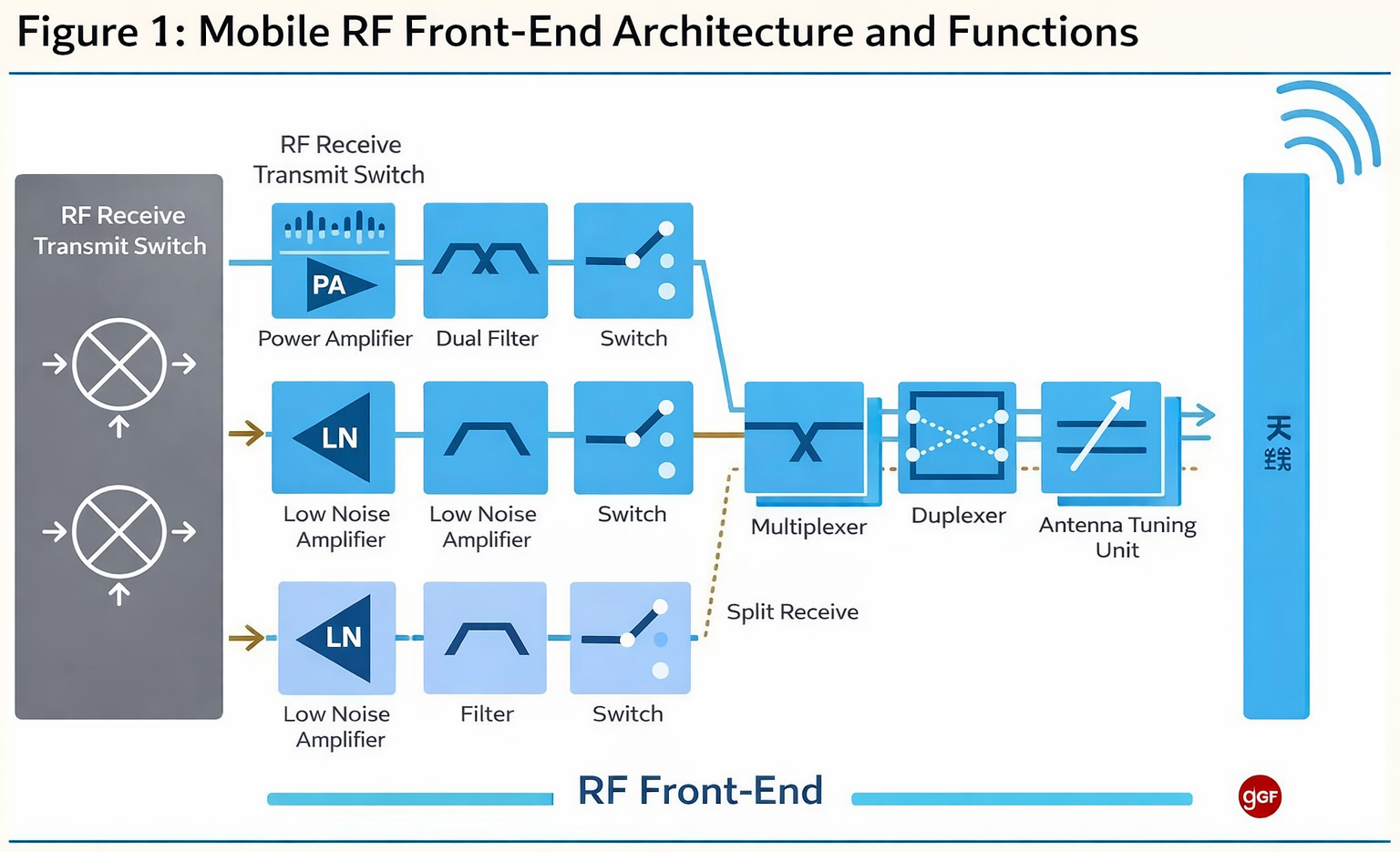
The RF front-end module is a core component of mobile terminal communication systems. Understanding it can be considered from two aspects: first, its necessity, as it is the essential pathway connecting the communication transceiver and the antenna; second, its importance, as its performance directly determines the communication modes that the mobile terminal can support, as well as key performance indicators such as received signal strength, call stability, and transmission power, directly affecting the end-user experience.
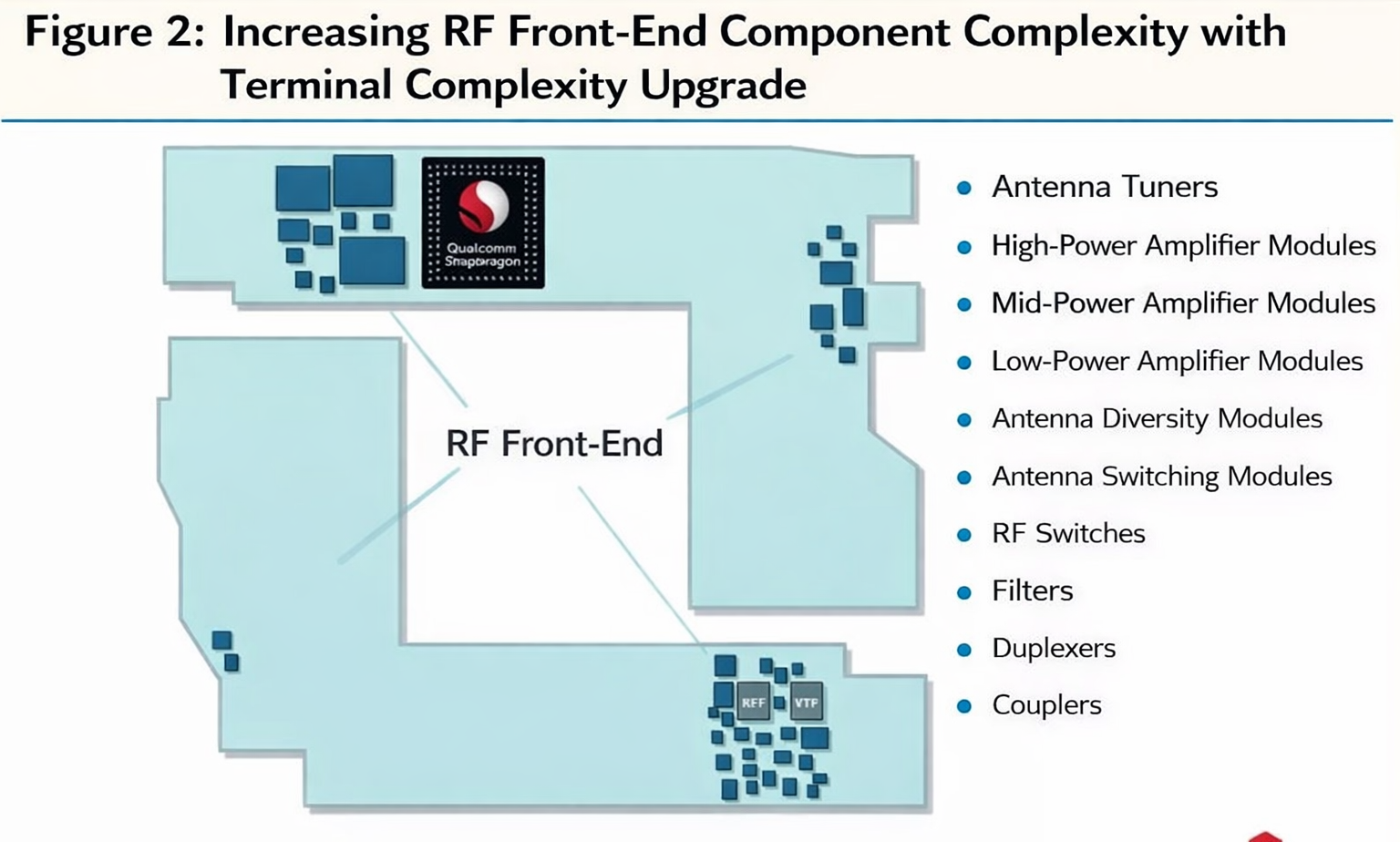
RF front-end chips include power amplifiers (PA), antenna switches (Switch), filters (Filter), duplexers and diplexers, and low-noise amplifiers (LNA), playing a core role in multi-mode/multi-frequency terminals. The largest market in the RF front-end industry is filters, which is expected to grow from $8 billion in 2017 to $22.5 billion in 2023, with a compound annual growth rate of up to 19%. This growth is mainly driven by the significant increase in the penetration of BAW filters, with typical applications such as ultra-high frequency bands defined by 5G NR and Wi-Fi diversity antenna sharing.
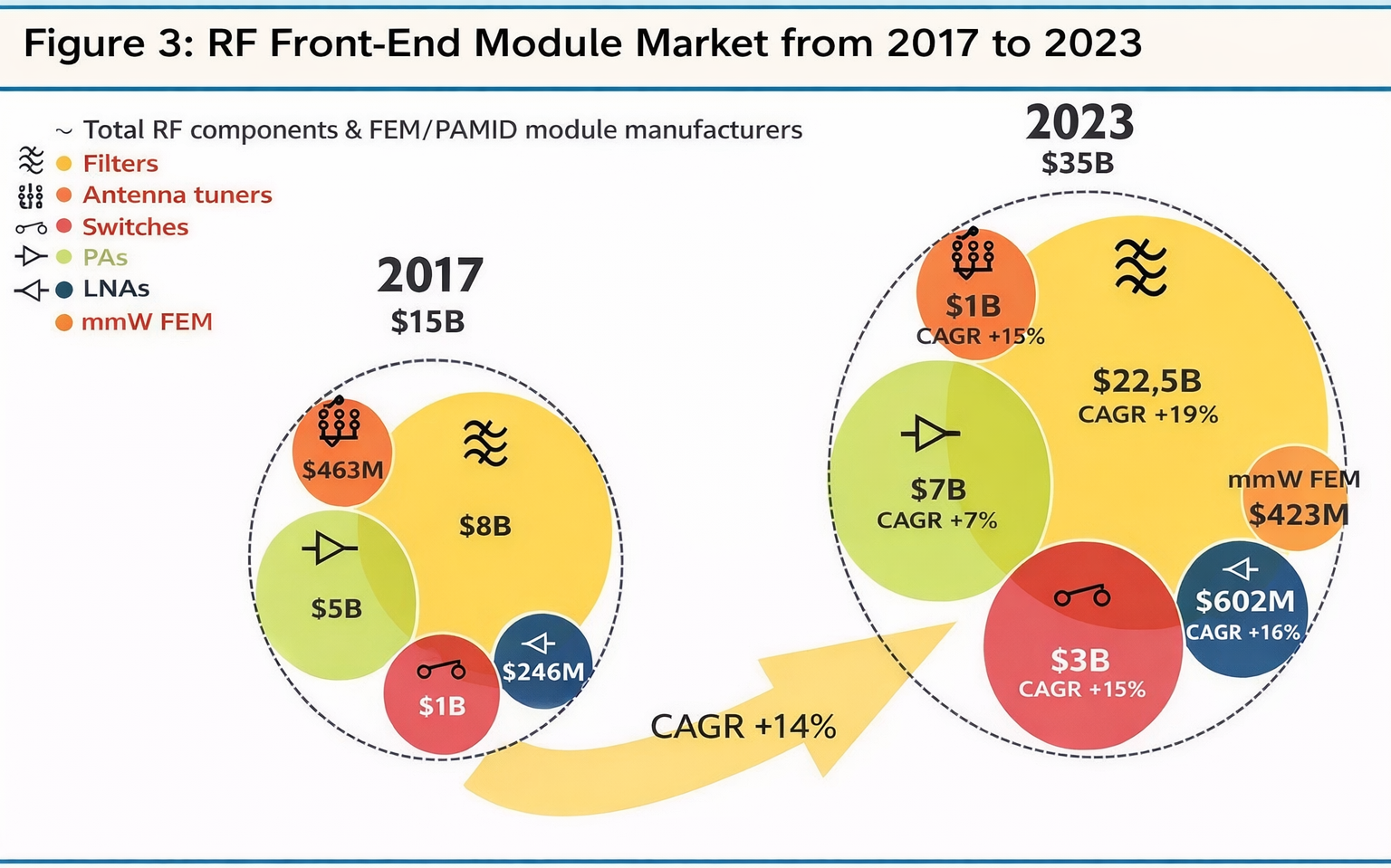
The power amplifier market is growing relatively steadily, with a compound annual growth rate of 7%, rising from $5 billion in 2017 to $7 billion in 2023. The growth of the high-end LTE power amplifier market, especially in the high and ultra-high frequency ranges, will offset the decline in the 2G/3G market.
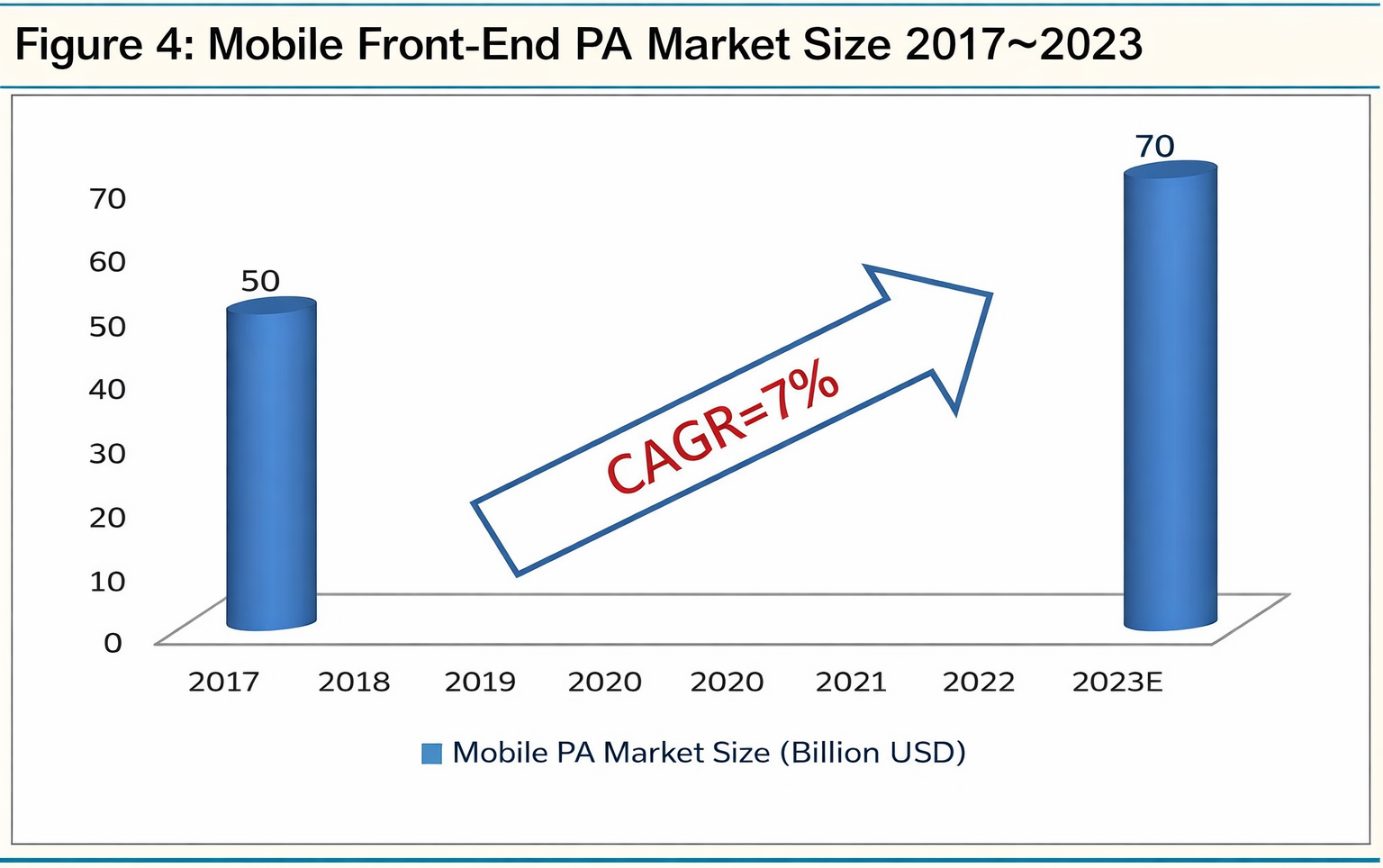
2. 5G drives the simultaneous rise in volume and price of mobile phone RF PAs.
RF front-ends evolve together with smart terminals.In the 4G era, smartphones generally adopted a 1-transmit, 2-receive architecture.With the addition of new bands in 5G—n41 (2.6 GHz), n77 (3.5 GHz), and n79 (4.8 GHz)—there will be changes to the RF front-end of 5G phones.Since 5G phones will continue to be compatible with 4G, 3G, and 2G standards, their RF front-end will be exceptionally complex.It is predicted that, in the 5G era, smartphones will adopt a 2-transmit, 4-receive scheme.
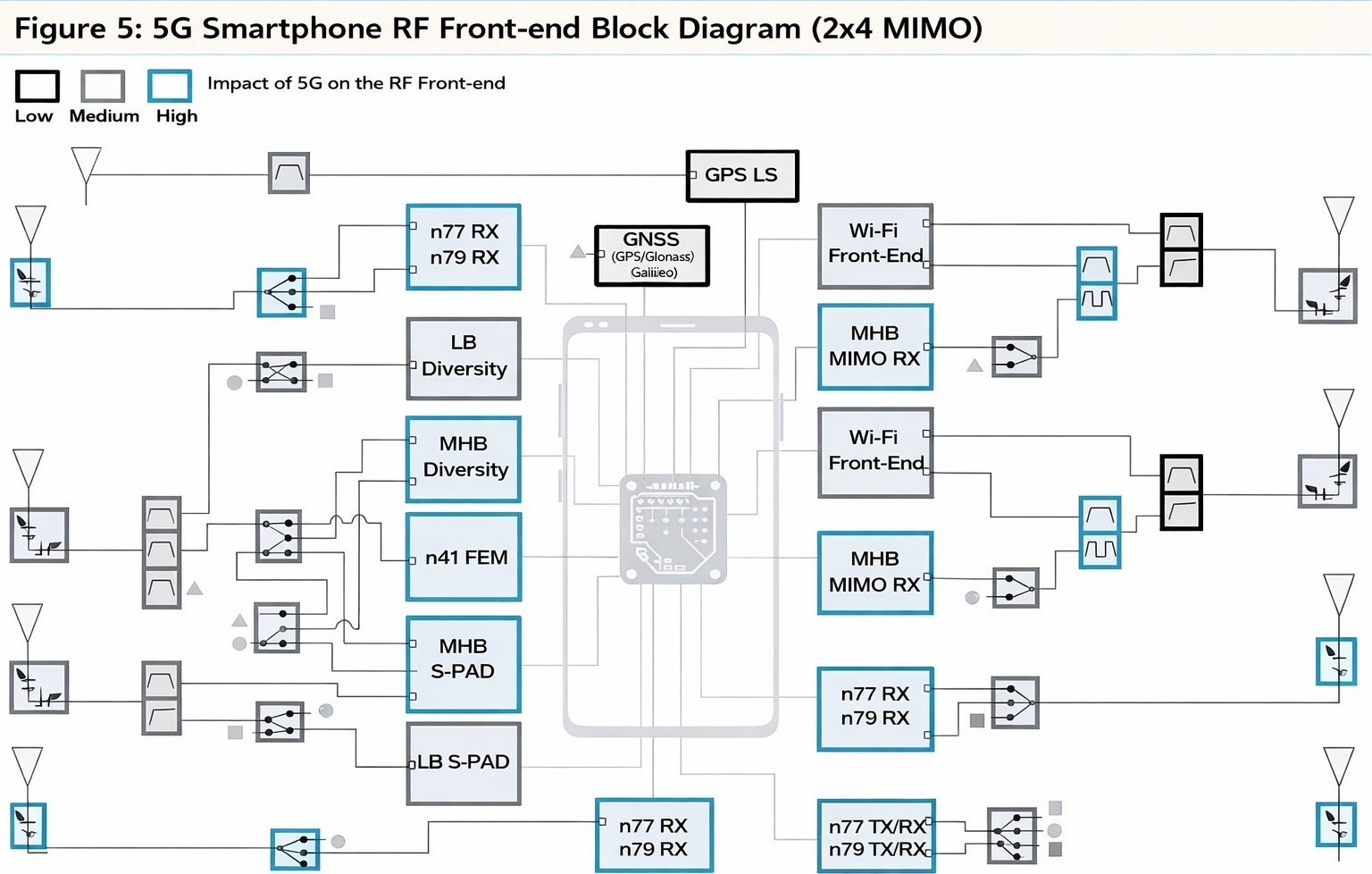
Whether at the base station end or the device terminal, the challenges 5G brings to suppliers are first reflected in the radio frequency aspect. This is because the RF front end is the key gateway for devices to access the network.
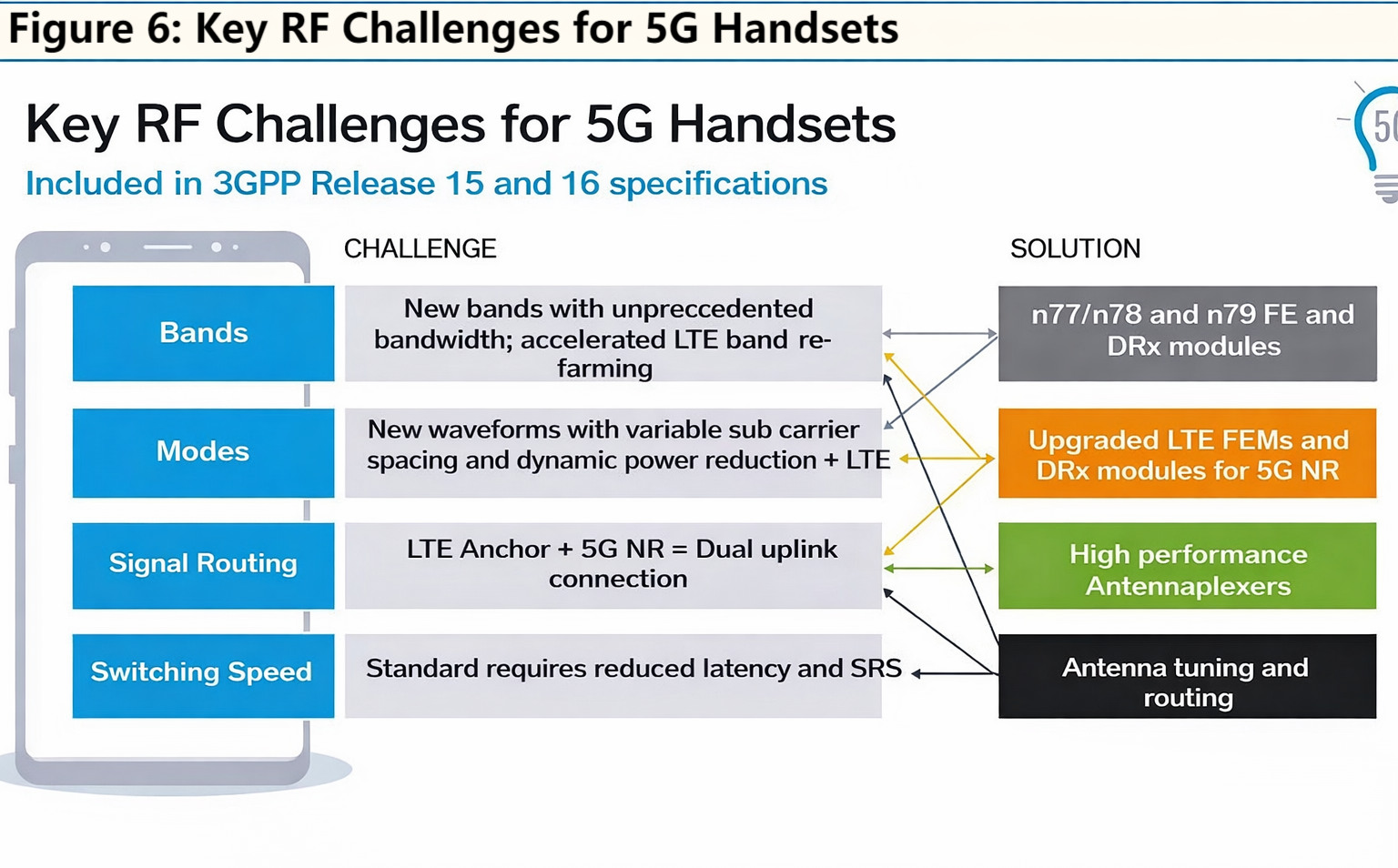
The upcoming 5G phones will face multiple challenges:
- Support for more frequency bands: We are moving from the familiar B41 to n41, n77, and n78. This requires devices to support more frequency bands.
- Different modulation directions: 5G focuses on high-speed connections, which brings new changes in modulation. This places higher demands on power consumption. For example, in the 4G era, the focus was more on ACPR. In the 5G era, attention needs to shift more to EVM, which is generally less than 1.5%.
- Signal routing choices: Deciding whether to use a 4G anchor with a 5G data connection, or to go directly with 5G, will bring different challenges.
- Changes in switching speed: Although there are not many changes in this area, SRS will also introduce new challenges.
Other factors, such as the introduction of new frequency bands like n77, n78, and n79, will affect the RF front-end configuration. This drives changes in front-end modules to meet the requirements of new frequency bands and new tuning methods.
The power amplifier (PA) is one of the most critical components in a mobile phone. It directly affects the phone’s wireless communication range, signal quality, and even standby time. In fact, it is the most important part of the RF system, second only to the baseband.
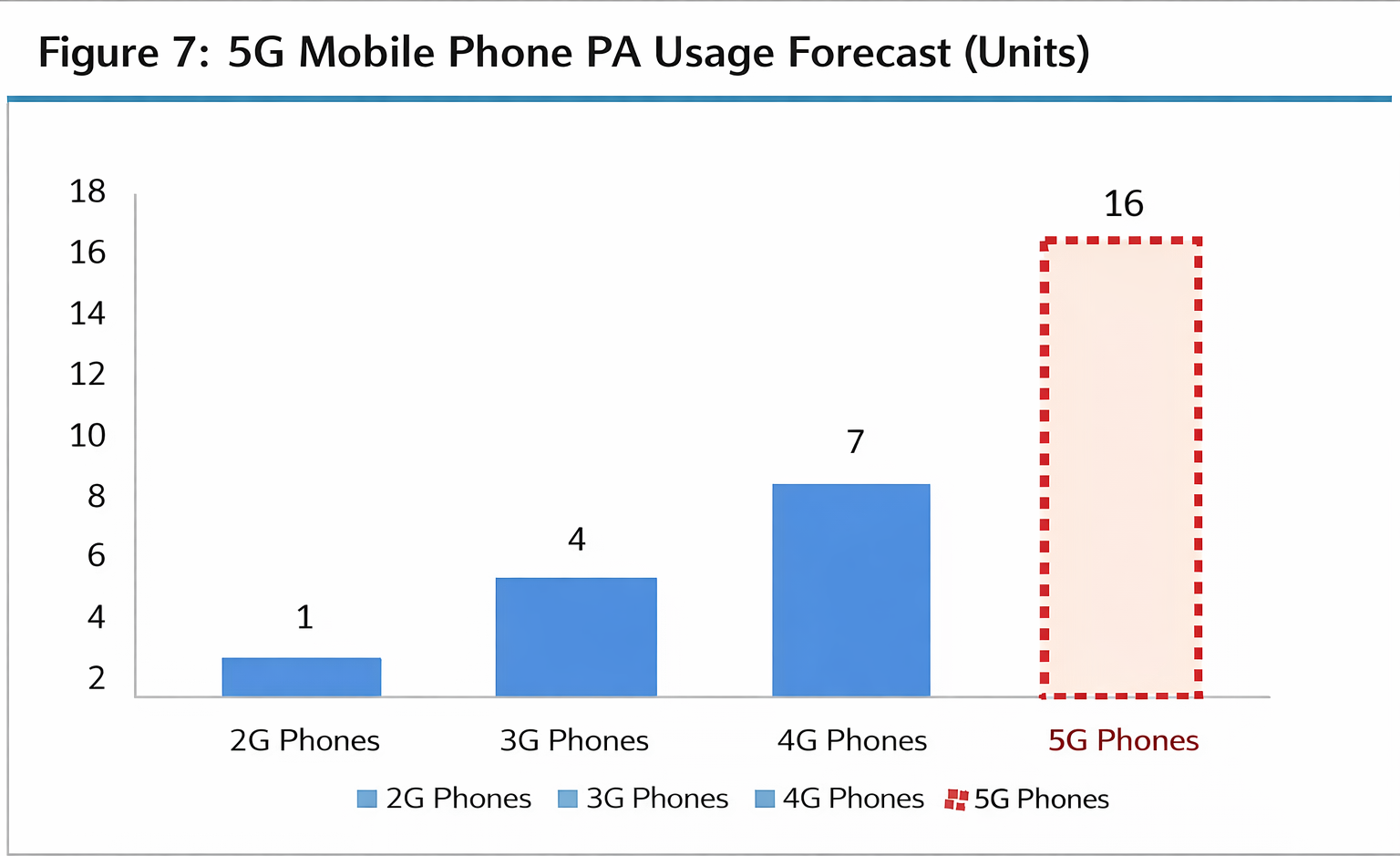
The number of PAs in mobile phones has steadily increased from 2G to 5G. As communication standards evolve, more frequency bands and higher performance requirements drive this growth.
For example, a 4G multi-mode, multi-band smartphone typically requires 5 to 7 PA chips. In contrast, a 5G smartphone may include up to 16 PA chips. This significant increase highlights the growing complexity of RF front-end design in the 5G era.
The value of a 5G mobile phone power amplifier (PA) is expected to reach $7.5,at the same time, the unit price of PAs has also increased significantly. The average unit price of PAs for 2G mobile phones is $0.3, for 3G mobile phones it rises to $1.25, while the consumption for all-mode 4G mobile phone PAs is as high as $3.25. It is expected that the value of 5G mobile phone PAs will exceed $7.5.
3. GaAs RF devices will continue to dominate the mobile phone market
In the 5G era, GaAs materials are well suited for mobile terminals. The electron mobility of GaAs is about six times higher than that of silicon (Si). In addition, GaAs has a direct bandgap. Because of these properties, GaAs devices offer superior high-frequency and high-speed performance compared to Si devices. As a result, GaAs is widely recognized as an ideal semiconductor material for communication applications.
In mobile wireless communication, most RF power amplifiers are currently based on GaAs materials. During the GSM era, domestic chip design companies such as RDA Microelectronics and Hantianxia took advantage of RF CMOS technology. They leveraged its high integration and low cost to challenge the dominance of traditional GaAs-based solutions from leading international manufacturers.
However, in the 4G era, the limitations of Si-based materials became more apparent. These include higher high-frequency losses, increased noise, and lower output power density. Because of these drawbacks, RF CMOS could no longer meet performance requirements. As a result, mobile phone RF power amplifiers returned to being dominated by GaAs processes.
Unlike RF power amplifiers, RF switches have followed a different trend. Around 90% of RF switches have shifted from traditional GaAs processes to SOI (Silicon on Insulator) technology. At the same time, most RF transceivers now adopt RF CMOS processes. This shift helps meet the growing demand for higher integration in modern communication systems.
4.Conclusion
In the 5G era, GaN materials are suitable for the base station side. In macro base station applications, GaN materials are gradually replacing Si LDMOS due to their advantages of high frequency and high output power; in micro base stations, for the time being, GaAs PA devices will still dominate because they currently have the market-validated reliability and cost-effectiveness advantages. However, as device costs decrease and technology improves, GaN PAs are expected to gain a share in micro base station applications. In mobile terminals, due to high cost and high supply voltage, GaN PAs are also unable to challenge the dominance of GaAs PAs in the short term.
In summary, as wireless communication continues to evolve from 4G to 5G and beyond, different semiconductor materials will play distinct roles across applications—from GaAs dominating mobile terminals to GaN driving high-power base station performance. Amid this rapidly changing landscape, selecting the right power amplifier technology remains critical to achieving optimal efficiency, linearity, and reliability.
At ZR Hi-Tech, we leverage deep expertise in RF design to deliver high-performance power amplifier solutions tailored to diverse application needs, from mobile communication systems to advanced wireless infrastructure. By combining proven technologies with flexible design capabilities, we help customers stay competitive in an increasingly demanding RF environment. If you want to know more, please contact us!