Newsroom
Linear RF Power Amplifier: Principles, Design Considerations, and Applications in Modern Wireless Sy...
In the rapidly evolving world of wireless communications, the linear RF power amplifier stands as a cornerstone technology, enabling reliable signal transmission across various applications. As demands for higher data rates, better spectral efficiency, and minimal distortion grow, understanding the intricacies of linear RF power amplifiers becomes essential for engineers and system designers.
This article delves into the principles behind these amplifiers, key design considerations, and their role in modern systems.
What Is a Linear RF Power Amplifier?
A linear RF power amplifier is a device designed to amplify radio frequency (RF) signals while maintaining a proportional relationship between the input and output signals. In essence, it boosts the power of an RF signal without introducing significant distortion, ensuring that the amplified output is a faithful replica of the input, scaled in amplitude.
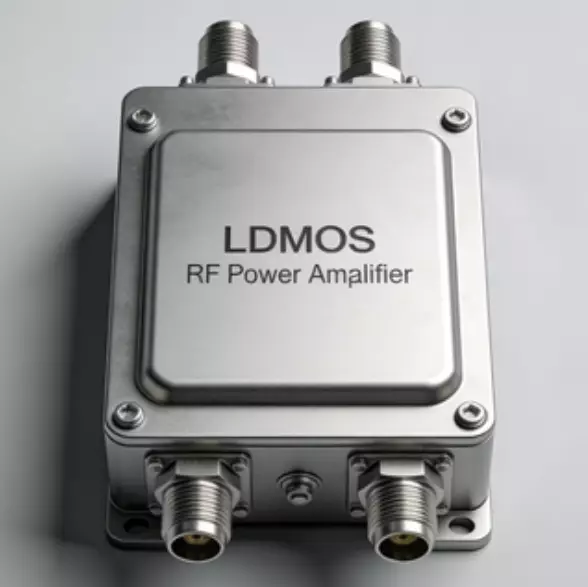
At its core, a linear RF power amplifier operates within the linear region of its active devices, typically RF power amplifier transistors such as GaN RF power amplifier (Gallium Nitride), LDMOS RF power amplifier (Laterally Diffused Metal Oxide Semiconductor), or GaAs (Gallium Arsenide). These amplifiers are crucial in systems where signal integrity is paramount, such as in modulation schemes that carry complex information like QAM (Quadrature Amplitude Modulation) used in 5G and Wi-Fi.
To visualize this, consider a basic schematic where the input signal passes through matching networks, amplification stages, and output matching to ensure maximum power transfer and minimal reflections. The linearity is quantified by metrics like the 1 dB compression point (P1dB), where the output power deviates by 1 dB from the ideal linear gain, and intermodulation distortion (IMD) products.
Linear RF power amplifiers differ from their non-linear counterparts by prioritizing fidelity over efficiency. While non-linear amplifiers might clip signals for higher power output, linear ones avoid saturation to preserve waveform accuracy. This makes them indispensable in transmitters where distortion could lead to spectral regrowth, interfering with adjacent channels.
In practice, these amplifiers are built with multiple stages: pre-driver, driver, and final power stage, each optimized for gain, power, and linearity. For instance, in a cellular base station, a linear RF power amplifier might handle signals from 100 MHz to several GHz, delivering watts to kilowatts of power.
Why Linearity Is Important in RF Power Amplifiers
Linearity in RF power amplifiers is critical because it directly impacts signal quality and system performance. When an amplifier operates non-linearly, it introduces harmonic distortion, intermodulation distortion, and compression, which can degrade the transmitted signal.
Harmonic distortion occurs when the amplifier generates multiples of the fundamental frequency, leading to unwanted emissions. Intermodulation distortion (IMD) is particularly problematic in multi-carrier systems, where two or more tones mix to produce spurious signals that fall within the passband or adjacent bands, causing interference.
In modern wireless systems, regulatory bodies like the FCC impose strict limits on out-of-band emissions, making linearity a compliance necessity. For example, in 5G networks using OFDM (Orthogonal Frequency Division Multiplexing), non-linearity can increase the error vector magnitude (EVM), reducing data throughput and reliability.
Moreover, linearity ensures that the amplifier can handle peak-to-average power ratios (PAPR) common in advanced modulations without clipping. High PAPR signals, like those in LTE or 5G NR, can reach peaks 10-12 dB above the average, pushing amplifiers into non-linear regions if not designed properly.
The importance of RF power amplifiers extends to receiver sensitivity; distorted transmissions can raise the noise floor in nearby receivers. In applications like satellite communications, where power is limited and distances are vast, maintaining linearity minimizes bit error rates.
To illustrate, graphs depicting input-output characteristics show the linear region where gain is constant, transitioning to compression. Distortion metrics like third-order intercept point (IP3) quantify how well an amplifier handles multiple tones without generating significant IMD.
RF Amplifier Classes Used for Linear Operation
RF power amplifiers are classified based on their bias and conduction angle, influencing efficiency and linearity. For linear operation, classes A, AB, and sometimes B are preferred.
Class A amplifiers conduct over the entire 360 degrees of the input cycle, biased at the midpoint of the transistor’s linear region. This provides excellent linearity with low distortion but at the cost of efficiency, typically around 25-30% for RF applications. They’re ideal for low-power, high-fidelity stages.
Class B amplifiers conduct for 180 degrees, using push-pull configurations to reconstruct the full waveform. While more efficient (up to 78.5% theoretically), they suffer from crossover distortion, making them less suitable for pure linear operation unless modified.
Class AB strikes a balance, conducting between 180 and 360 degrees, reducing crossover distortion while improving efficiency over Class A. This class is widely used in linear RF power amplifiers for wireless communications, offering good linearity with efficiencies of 50-60%.
In RF contexts, these classes are implemented with tuned loads or broadband RF power amplifier matching. For instance, in a GaN-based Class AB amplifier, harmonic terminations help suppress distortions.
OtherRF power amplifier classes like C, D, E, and F prioritize efficiency but are non-linear, requiring linearization techniques for use in linear applications. Diagrams of conduction angles highlight how Class A maintains full-cycle operation for minimal distortion.
Techniques for Improving RF Amplifier Linearity
Enhancing linearity often involves advanced techniques to counteract inherent non-linearities in power devices.
Predistortion is a popular method, where the input signal is deliberately distorted in the opposite way to the amplifier’s non-linearity, resulting in a linear output. Digital predistortion (DPD) uses DSP to model the amplifier’s behavior and apply corrections in real-time, effective for wideband RF power amplifier signals.
Feedforward linearization subtracts distortion products post-amplification using an auxiliary path, though it’s complex and power-hungry. Envelope tracking (ET) dynamically adjusts the supply voltage to match the signal envelope, keeping the amplifier in its linear region and boosting efficiency. Cartesian feedback loops sense the output and adjust the input to minimize errors, useful in narrowband applications.
Doherty architecture combines a main linear amplifier with a peaking amplifier for efficiency at back-off, maintaining linearity over a range of power levels. Block diagrams of DPD show adaptive algorithms updating coefficients based on feedback.
Design Considerations for Linear RF Power Amplifiers
Designing a linear RF power amplifier involves balancing gain, power, efficiency, linearity, and thermal management. RF power amplifier key parameters include frequency range, output power, gain flatness, and return loss. Material choice is vital; GaN offers high power RF amplifiers density and efficiency for high frequencies.
Matching networks ensure impedance transformation, using microstrip lines or lumped elements. Stability analysis prevents oscillations, employing techniques like K-factor calculation. Thermal design is critical, as heat dissipation affects reliability. Heatsinks, fans, or liquid cooling manage junction temperatures.
Power supply decoupling minimizes noise, while bias networks maintain operating points.
Simulation tools like ADS or HFSS aid in modeling non-linear effects, optimizing for P1dB and IP3. Integration with DPD requires feedback paths and high-speed ADCs/DACs.
Applications of Linear RF Power Amplifiers
Linear RF power amplifiers are ubiquitous in wireless systems.
In cellular base stations, they amplify signals for 4G/5G, supporting massive MIMO with arrays of amplifiers. Satellite transponders use them for uplink/downlink, where linearity preserves signal quality over long distances.
Radar systems, like phased arrays, rely on linearity for accurate pulse transmission. Broadcasting, medical imaging (MRI), and RF power amplifier test equipment also employ them. In 5G, they enable mmWave bands with beamforming.
Linear RF Power Amplifier vs High-Efficiency Amplifier
Linear amplifiers prioritize fidelity, often at lower efficiency (30-50%), while high-efficiency ones (Class D/E/F) achieve 70-90% but introduce distortion. The tradeoff is evident in graphs showing efficiency dropping as linearity improves.
High-efficiency amps use switching modes, suitable for constant-envelope signals, but need linearization for complex modulations. In battery-powered devices, efficiency is key, but in base stations, linearity takes precedence.
Common Challenges in Linear RF Amplifier Design
Challenges include thermal runaway, where heat causes bias for RF power amplifiers shifts. PIM (Passive Intermodulation) from components degrades linearity. Wideband operation complicates matching. Cost and size constraints push for integration. Aging and environmental factors affect performance. Thermal images highlight hotspots in RF power amplifier designs.
Conclusion
Linear RF power amplifiers remain vital for modern wireless systems, balancing performance demands. As technologies advance, innovations in materials and techniques will enhance their capabilities, ensuring reliable communications-just contact us!