Newsroom
Digital RF Power Amplifier: Architecture, Working Principles, Advantages, and Applications
As demands for higher efficiency, better linearity, and adaptability increase, digital RF power amplifiers are transforming applications from telecommunications to radar systems.
This article explores the fundamentals, from what a digital RF power amplifier is to its future trends, providing engineers and RF specialists with in-depth insights into this essential technology.
What Is a Digital RF Power Amplifier?
A digital RF power amplifier is an electronic device designed to amplify radio frequency signals using digital signal processing techniques, converting low-power RF inputs into high-power outputs suitable for transmission. Unlike traditional amplifiers, a digital RF power amplifier integrates digital modulation and control, often employing switching modes to achieve superior performance.
At its core, a digital RF power amplifier processes signals in the digital domain before amplification, leveraging components like digital-to-analog converters (DACs) and pulse-width modulation (PWM) to handle complex waveforms. This approach allows for precise control over output power, making it ideal for applications requiring high fidelity and efficiency. For instance, in 5G base stations, digital RF power amplifiers manage multi-carrier signals with minimal distortion.
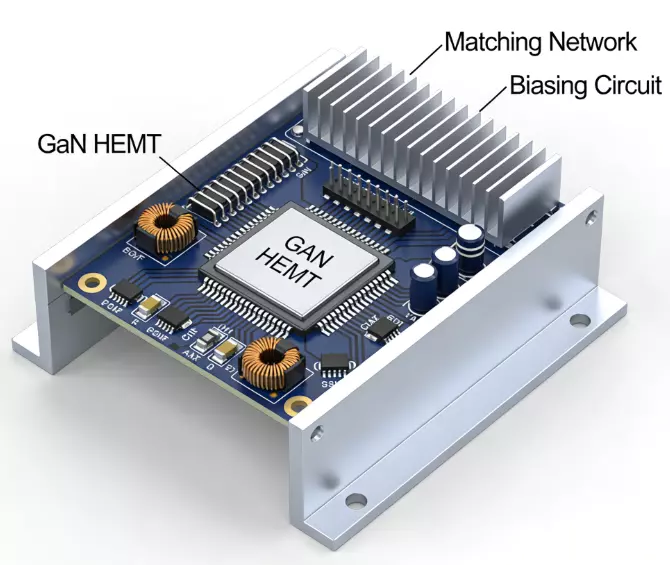
Key characteristics include high power RF amplifier added efficiency (PAE), typically exceeding 50%, and the ability to operate across wide frequency bands, from MHz to GHz. Materials like Gallium Nitride (GaN) are commonly used in RF power amplifier transistors for their high breakdown voltage and thermal stability, enabling compact designs without sacrificing power.
How Does a Digital RF Power Amplifier Work?
The working principle of a digital RF power amplifier revolves around converting an input RF signal into a digital format, processing it for optimization, and then amplifying it through switching transistors. The process begins with the input stage, where the analog RF signal is digitized using an analog-to-digital converter (ADC). This digital representation allows for advanced techniques like digital predistortion (DPD) to correct nonlinearities before amplification.
Once digitized, the signal undergoes modulation, often via PWM, where the duty cycle varies with the signal amplitude. Power transistors, such as MOSFETs or GaN HEMTs, act as switches: fully on for low resistance and minimal power loss, or fully off to block current. This switching operation minimizes heat generation, achieving efficiencies up to 90%.
The amplified signal is then filtered to remove harmonics and reconstructed into a clean RF output. Envelope tracking further enhances efficiency by dynamically adjusting the supply voltage to match the signal envelope, reducing power waste during low-amplitude periods. In practice, this enables digital RF power amplifiers to handle high peak-to-average power ratios (PAPR) in modern modulations like OFDM used in LTE and 5G.
Digital vs. Analog RF Power Amplifiers: What’s the Difference?
While both digital and analog RF power amplifiers aim to boost signal strength, their approaches differ significantly in signal processing, efficiency, and adaptability.
Analog RF power amplifiers operate continuously, using transistors in linear modes (e.g., Class A, AB) to amplify signals directly. This results in high linearity but poor efficiency, often below 50%, due to constant power dissipation as heat. They excel in applications requiring minimal distortion, like high-fidelity audio, but struggle with complex digital modulations.
In contrast, digital RF power amplifiers digitize the signal early, enabling techniques like DPD and envelope tracking for better linearity and efficiency. Switching modes (e.g., Class D RF power amplifier) reduce power loss, making them more efficient (up to 90%) and compact. However, they may introduce switching noise, mitigated by advanced filtering.
Key differences include:
- Efficiency: Digital > Analog.
- Linearity: Analog naturally better, but digital compensates with DSP.
- Complexity: Digital requires more processing power but offers flexibility.
- Applications: Analog for simple, low-power scenarios; digital for high-data-rate systems like 5G.
Key Advantages of Digital RF Power Amplifiers
Digital RF power amplifiers offer several compelling advantages of RF power amplifier that make them preferable in modern RF systems.
- High Efficiency: By operating transistors as switches, they minimize energy loss, achieving PAE over 50-90%, crucial for battery-powered devices and reducing operational costs in base stations.
- Improved Linearity: Techniques like DPD correct distortions in real-time, allowing operation closer to saturation without spectral regrowth, essential for multi-carrier signals.
- Flexibility and Adaptability: Digital processing enables software-defined adjustments, supporting multiple standards (e.g., 4G/5G) without hardware changes.
- Compact Size and Lower Heat: Higher efficiency means less cooling required, enabling smaller form factors for applications like drones and satellites.
- Cost-Effectiveness Over Time: Initial complexity is offset by reduced power consumption and maintenance, leading to lower total ownership costs.
These benefits position digital RF power amplifiers as the go-to choice for next-generation wireless infrastructure.
Common Digital RF Power Amplifier Architectures
Several architectures define digital RF power amplifiers, each suited to specific needs.
- Class D: Uses PWM for high efficiency (>90%) in switching mode, ideal for broadband applications. However, it requires careful filtering to manage harmonics.
- Doherty Amplifier: Combines a carrier amplifier (Class AB) with a peaking amplifier (Class C) for efficiency at varying power levels, common in cellular base stations for handling PAPR.
- Envelope Tracking (ET): Dynamically modulates supply voltage to match the signal envelope, boosting efficiency in wideband RF power amplifier scenarios like 5G.
- Outphasing (LINC): Splits the signal into constant-amplitude components, amplified separately and recombined, offering high linearity but complex implementation.
- Distributed Amplifiers: Use multiple stages for ultra-wideband operation, though power is limited by voltage constraints.
GaN-based designs dominate these architectures for their high power density and frequency handling.
Applications of Digital RF Power Amplifiers
Digital RF power amplifiers find extensive use across industries due to their versatility.
- Telecommunications: In 5G base stations, they amplify signals for massive MIMO, ensuring reliable coverage and high data rates.
- Radar and Defense: High-power pulsed amplifiers enable long-range detection in military radars and electronic warfare systems.
- Satellite Communications: Compact, efficient designs support on-board amplification for broadband RF power amplifier
- Medical Equipment: Used in MRI and RF ablation devices for precise power delivery.
- Industrial: In plasma generation and RF heating, they provide consistent high power.
These applications highlight the amplifier’s role in enabling advanced RF systems.
Design Challenges in Digital RF Power Amplifiers
Designing digital RF power amplifiers presents several hurdles.
- Linearity vs. Efficiency Trade-off: High efficiency often compromises linearity; DPD helps but increases complexity.
- Thermal Management: High power densities generate heat, requiring advanced cooling like heatsinks or liquid systems.
- Bandwidth Limitations: Wideband operation risks instability; careful matching networks are essential.
- Noise and Interference: Switching introduces harmonics, demanding robust filtering.
- Cost and Integration: Incorporating DSP raises costs; miniaturization challenges dense electronics.
Addressing these requires simulation tools and materials like GaN for better performance.
How to Choose a Digital RF Power Amplifier for Your System
Selecting the right digital one involves evaluating RF power amplifier key parameters.
- Frequency and Bandwidth: Ensure compatibility with your operating range, e.g., sub-6 GHz for 5G.
- Power Output and Gain: Match P1dB and gain to system needs, considering PAPR.
- Efficiency (PAE): Prioritize >50% for energy-sensitive applications.
- Linearity Metrics: Check IMD3 and ACPR for distortion control.
- Size, Weight, and Power (SWaP): Opt for compact GaN-based units.
- Reliability and Cost: Review MTBF and total cost, including integration.
Start by knowing your signal type and use tools like datasheets for comparison.
Future Trends in Digital RF Power Amplifier Technology
The future of digital RF power amplifiers is shaped by emerging technologies.
- GaN and SiC Integration: These materials will dominate for higher frequencies and efficiencies in 6G.
- AI and ML Optimization: Real-time adaptive DPD using AI for better performance.
- Solid-State RF power amplifier Shift: Moving from tubes to GaN SSPAs for satellites, reducing size and power use.
- Sustainability Focus: Energy-efficient designs to meet green standards.
- Millimeter-Wave Expansion: For ultra-high-speed wireless communications in RF power amplifier, with market growth projected at 12% CAGR.
These trends promise more integrated, efficient amplifiers.
Conclusion
Digital RF power amplifiers represent a pinnacle of RF engineering, offering unmatched efficiency and flexibility for today’s connected world. From their architectures to applications, they drive innovation in communications and beyond. As technology advances, staying informed on these developments is key for engineers. For reliable solutions, consider RF power amplifier manufacturer like ZR Hi-Tech, who continue to push boundaries in this field–just contact us!