Newsroom
Broadband RF Power Amplifier Module: A Complete Guide to Wideband Performance and Applications
Broadband RF power amplifier modules stand out as versatile solutions, capable of handling signals from hundreds of MHz to several GHz while delivering consistent power output. This comprehensive guide explores everything buyers need to know, from fundamental concepts to future trends, helping you make informed decisions for your systems.
What Is a Broadband RF Power Amplifier Module?
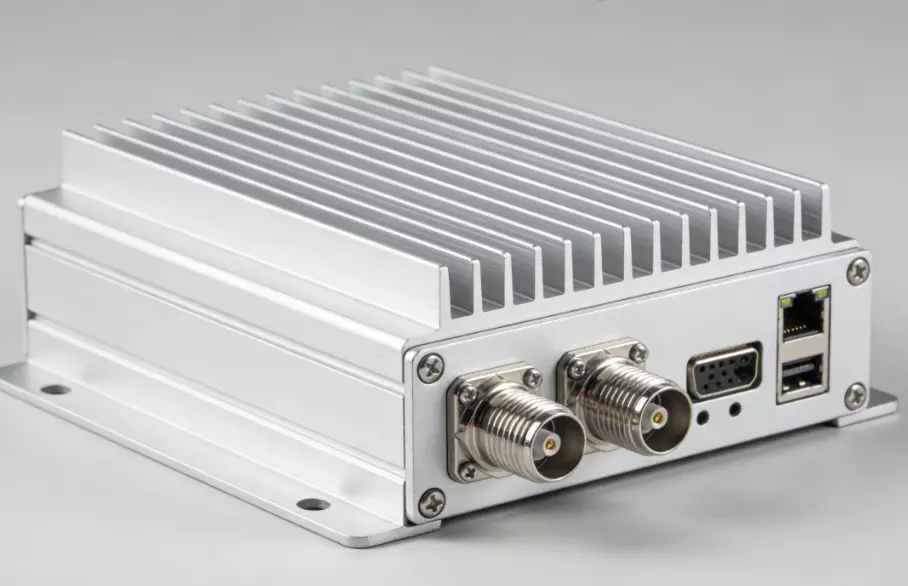
A broadband RF power amplifier module is an electronic device designed to boost the power of radio frequency (RF) signals over a wide frequency spectrum without significant distortion or loss of fidelity. Unlike traditional amplifiers that operate efficiently only within narrow frequency bands, broadband modules maintain performance across octave or multi-octave ranges, such as 2 GHz to 18 GHz or even broader. These modules typically integrate active components like RF power amplifier transistors (often GaN or LDMOS), passive elements for matching, and sometimes control circuitry into a compact, modular package.
At its core, the module takes a low-power input signal—often from a signal generator or transceiver—and amplifies it to levels suitable for transmission, RF power amplifier testing, or jamming. For instance, models from manufacturers like Pasternack offer 1W to 2W output in the 2-18 GHz range, making them ideal for lab or field use. ZR’s broadband modules emphasize ruggedness and efficiency, ensuring they perform in harsh environments like military deployments or industrial settings. Key features include high gain (typically 15-50 dB), low noise figures (<5 dB), and robust protection against mismatches, which prevent damage from reflected power.
Broadband amplifiers are essential in scenarios where frequency agility is required, such as software-defined radios (SDRs) or multi-band systems. They differ from narrowband counterparts by prioritizing versatility over peak efficiency in a single band, though advancements in materials like gallium nitride (GaN) are closing this gap.
How Does a Broadband RF Power Amplifier Module Work?
The operation of a broadband RF power amplifier module revolves around signal amplification while preserving bandwidth and linearity. The process begins with the input RF signal entering the module via a connector (e.g., SMA). This signal is first matched to the amplifier’s input impedance—typically 50 ohms—to maximize power transfer and minimize reflections.
Inside the module, the core amplification occurs through one or more transistor stages. In modern designs, GaN transistors are common due to their high power RF amplifier density and efficiency. For example, a GaN-based module might use a push-pull configuration to handle wideband signals. The transistor boosts the signal’s amplitude, with gain controlled by bias networks that set the operating point (e.g., Class AB for a balance of linearity and efficiency).
To achieve broadband performance, the module incorporates wideband matching networks, such as distributed elements or transformers, which maintain flat gain across frequencies. Output stages include harmonic filters to suppress unwanted spurs, ensuring clean amplification. Heat management is critical; modules often feature integrated heatsinks or fans, as power dissipation can reach 50-100W in high-output RF power amplifier designs.
Consider a typical workflow: A 0 dBm input at 5 GHz might be amplified to +33 dBm (2W) with 33 dB gain. Efficiency (power added efficiency, PAE) could be 30-50%, meaning the module converts DC power effectively into RF output.
Key Specifications Buyers Should Evaluate
When selecting a broadband RF power amplifier module, focus on specifications that align with your application’s needs. Frequency range is paramount—ensure it covers your operational bands, like 0.5-6 GHz for versatile use. Power output, measured as P1dB (1 dB compression point) or Psat (saturation power), indicates the maximum undistorted power; aim for 10-100W depending on requirements.
Gain should be flat (±2 dB variation) across the bandwidth to avoid signal inconsistencies. Efficiency (PAE >30%) impacts operational costs and heat generation. Linearity metrics, such as third-order intermodulation distortion (IMD3 <-30 dBc) and adjacent channel leakage ratio (ACLR), are crucial for modulated signals in 5G or radar to prevent spectral regrowth.
Other key specs include noise figure (<5 dB for low-noise applications), VSWR (<1.5:1 for good matching), and harmonic suppression (>40 dBc). Operating temperature range (-40°C to +85°C) and MTBF (mean time between failures) ensure reliability.
Common Applications of Broadband RF Power Amplifier Modules
Broadband RF power amplifier modules are indispensable in diverse fields. In wireless communications, they power base stations for 4G/5G networks, amplifying signals across 600 MHz-6 GHz for multi-band coverage and higher data rates.
Radar systems rely on them for target detection, where wideband amplification enables frequency agility in electronic warfare (EW). In EW jamming, modules disrupt enemy signals across multiple bands. Test and measurement equipment uses broadband RF power amplifiers for signal generation in labs, ensuring accurate EMI/EMC testing up to 50 GHz. Aerospace applications include satellite uplinks, while medical devices like MRI systems benefit from precise amplification.
Broadband vs Narrowband RF Power Amplifier Modules
Broadband and narrowband RF power amplifier modules serve different purposes. Broadband modules cover wide frequency ranges (e.g., 1-18 GHz), offering versatility for multi-frequency systems like SDRs. They handle higher data rates but face challenges in maintaining uniform gain and efficiency, often resulting in lower peak performance (e.g., 30-40% efficiency).
Narrowband modules optimize for specific bands (e.g., 2.5-2.7 GHz), achieving higher efficiency (up to 70%) and power density. They’re ideal for applications like single-frequency radars, where range and power per watt are critical. However, they lack flexibility, requiring multiple units for broad coverage.
Broadband designs use techniques like distributed amplification for flat response, while narrowband employs resonant matching for optimization. Buyers should choose broadband for agile systems and narrowband for efficiency-focused ones.
Design Challenges in Broadband RF Power Amplification
Designing broadband RF power amplifiers presents significant hurdles. Achieving uniform gain and efficiency across wide bandwidths is tough; parasitic effects cause roll-off at higher frequencies, necessitating compensation like multi-stage cascading or resistive loading.
Impedance matching over octaves is complex—traditional methods fail, so designers use tapered lines or baluns, which introduce losses. Linearity vs. efficiency trade-offs are prominent; high linearity avoids distortion but reduces PAE. Digital predistortion (DPD) helps, but adds complexity.
Heat dissipation is a major issue, as high-power broadband operation generates substantial thermal loads. Materials like GaN on SiC improve this, but require advanced cooling. Stability against oscillations and VSWR tolerance are also critical.
How to Choose the Right Broadband RF Power Amplifier Module
Selecting the right module starts with defining requirements: frequency range, output power, and modulation type. For high-linearity needs (e.g., OFDM), prioritize IMD3 and ACLR. Calculate drive power—ensure input matches your source to avoid compression.
Consider efficiency for battery-powered or remote applications. Evaluate form factor and integration—modules with built-in heatsinks simplify design. Budget for features like remote control or blanking. Use steps like knowing your signal, calculating needs, and comparing types (module vs. system).
Integration Tips for System Designers and OEMs
Integrating broadband RF power amplifier modules requires careful planning. Start with impedance matching—use networks to align with antennas or loads, minimizing VSWR. Proper biasing ensures optimal operation.
Heat management is key—mount on heatsinks with thermal compound, ensuring airflow. Power supply must be stable; use decoupling capacitors to prevent ripple. Protect against overdrive with limiters or attenuators.
For systems, incorporate monitoring like temperature sensors and VSWR detectors. In multi-module setups, use combiners for higher power. Test for EMI compliance.
Future Trends in Broadband RF Power Amplifier Modules
The future of broadband RF power amplifiers is shaped by 5G/6G, AI integration, and advanced materials. GaN and SiC will dominate, enabling higher efficiencies (70-83%) and mmWave support (26-40 GHz). Integrated modules with DPD and adaptive bias will enhance linearity without sacrificing power.
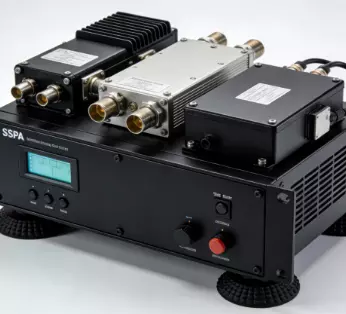
AI-driven optimization for real-time performance tuning is emerging, reducing emissions and extending life. Market growth to $21.2B by 2035 reflects demand in SATCOM and EW. Solid-state RF power amplifier GaN SSPAs are replacing tubes for reliability.
Conclusion
Broadband RF power amplifier modules are vital for modern RF systems, offering wideband versatility and robust performance. From understanding their workings to navigating design challenges and trends, this guide equips buyers with essential knowledge. As a RF power amplifier manufacturer, we at ZR Hi–Tech invite you to explore our range—contact us for tailored solutions that meet your wideband needs.