Newsroom
MMIC RF Power Amplifier: Design, Advantages, Applications, and Selection Guide
The MMIC RF Power Amplifiers are essential for boosting signal strength in microwave and millimeter-wave applications, enabling everything from wireless communications to radar systems. This comprehensive guide delves into the intricacies of MMIC RF Power Amplifiers, covering their design principles, key benefits, underlying technologies, operational ranges, and practical considerations for integration and selection.
What Is a MMIC RF Power Amplifier?
A Monolithic Microwave Integrated Circuit (MMIC) RF Power Amplifier is an integrated circuit designed to amplify RF signals at microwave frequencies, typically ranging from 300 MHz to 300 GHz. Unlike traditional discrete amplifiers, an MMIC RF Power Amplifier integrates all necessary components—such as RF power amplifier transistors, resistors, capacitors, and matching networks—onto a single semiconductor substrate. This monolithic approach allows for compact, efficient amplification of high-frequency signals with significant power output.
The core of an MMIC RF Power Amplifier is usually based on field-effect transistors (FETs) or high-electron-mobility transistors (HEMTs), fabricated using advanced semiconductor processes. These amplifiers are optimized for power amplification rather than low-noise or small-signal applications, focusing on delivering high output power while maintaining linearity and efficiency. For instance, in satellite communications, an MMIC RF Power Amplifier might handle signals in the Ku-band (12-18 GHz) to ensure reliable data transmission over long distances.
The development of MMIC technology dates back to the 1970s, driven by the need for smaller, more reliable RF systems in defense and aerospace. Today, MMIC RF Power Amplifiers are ubiquitous in modern electronics, powering 5G infrastructure, radar RF power amplifier modules, and wireless networks. Their integrated nature reduces parasitic effects, which are common in discrete designs, leading to better performance at higher frequencies.
How Does a MMIC RF Power Amplifier Work?
At its fundamental level, an MMIC RF Power Amplifier operates by taking a low-power RF input signal and increasing its amplitude through controlled energy transfer from a DC power supply. The amplification process relies on the active device’s ability to modulate current or voltage in response to the input signal.
In a typical MMIC RF Power Amplifier, the input signal is fed into a gate or base of the transistor, which controls the flow of charge carriers through the channel. This modulation results in an amplified output at the drain or collector. To optimize performance, MMIC designs incorporate input and output matching networks directly on the chip to minimize reflections and maximize power transfer. These networks often use transmission lines, inductors, and capacitors etched into the substrate.
Power amplification classes play a crucial role in operation. Class-A MMIC RF Power Amplifiers provide high linearity but low efficiency (around 50%), making them suitable for applications requiring minimal distortion. Class-AB offers a balance, with efficiencies up to 60-70%, while Class-C can achieve over 70% efficiency but at the cost of linearity, often used in pulsed systems. Advanced RF power amplifier designs may employ Doherty or envelope-tracking techniques to enhance efficiency across varying power levels.
Thermal management is integral, as high power RF amplifier densities generate significant heat. The MMIC substrate, often gallium arsenide (GaAs) or gallium nitride (GaN), dissipates this heat, preventing performance degradation or failure. Biasing circuits for RF power amplifier ensure stable operation, with feedback loops sometimes integrated to maintain gain flatness over temperature and frequency.
What Are the Key Advantages of MMIC RF Power Amplifiers?
MMIC RF Power Amplifiers offer several compelling advantages over discrete counterparts, making them ideal for space-constrained and high-reliability applications.
First, their compact size and lightweight construction enable integration into dense systems like phased-array antennas or portable devices. By fabricating all elements on a single chip, MMICs reduce the overall footprint, which is critical in aerospace and RF power amplifier for mobile communications where size and weight directly impact system viability.
Second, MMIC RF Power Amplifiers exhibit consistent performance with minimal variation between units. This repeatability stems from the monolithic fabrication process, which minimizes assembly errors and parasitic inductances that plague discrete designs. As a result, engineers can achieve predictable gain, output power, and efficiency without extensive tuning.
Third, they provide superior high-frequency performance. At microwave and mmWave bands, discrete components suffer from increased losses due to interconnects, but MMICs integrate short paths, reducing signal degradation. This leads to better power added efficiency (PAE) and lower noise figures in power stages.
Additionally, MMICs simplify design and manufacturing. Pre-matched inputs and outputs (often to 50 ohms) ease integration, reducing development time and costs. They also enhance reliability by eliminating solder joints and connectors prone to failure in harsh environments.
However, these advantages of RF power amplifier come with trade-offs, such as potentially lower maximum power output compared to discrete amplifiers, due to thermal limitations in the small die area.
What Technologies Are Used in MMIC RF Power Amplifiers?
MMIC RF Power Amplifiers leverage various semiconductor technologies tailored to specific performance needs.
Gallium Arsenide (GaAs) is a staple, offering high electron mobility for excellent gain and efficiency up to Ka-band (26-40 GHz). GaAs pHEMTs (pseudomorphic HEMTs) are common for medium-power applications, providing PAE up to 50%.
Gallium Nitride (GaN) has emerged as a powerhouse for high-power scenarios, thanks to its wide bandgap and high breakdown voltage. GaN MMICs deliver output powers exceeding 20W in Ku-band, with efficiencies over 40% in broadband RF power amplifier operations.
Silicon Germanium (SiGe) and CMOS RF power amplifier are used for lower-power, cost-sensitive designs, particularly in sub-6 GHz 5G bands, where integration with digital logic is beneficial.
Advanced processes like indium phosphide (InP) enable mmWave frequencies beyond 100 GHz, ideal for emerging 6G research. Fabrication involves epitaxial growth, lithography, and etching to create layered structures optimizing electron flow.
Hybrid approaches sometimes combine technologies, such as GaN RF power amplifier on silicon carbide (SiC) substrates for better thermal conductivity.
What Frequency Ranges Do MMIC RF Power Amplifiers Cover?
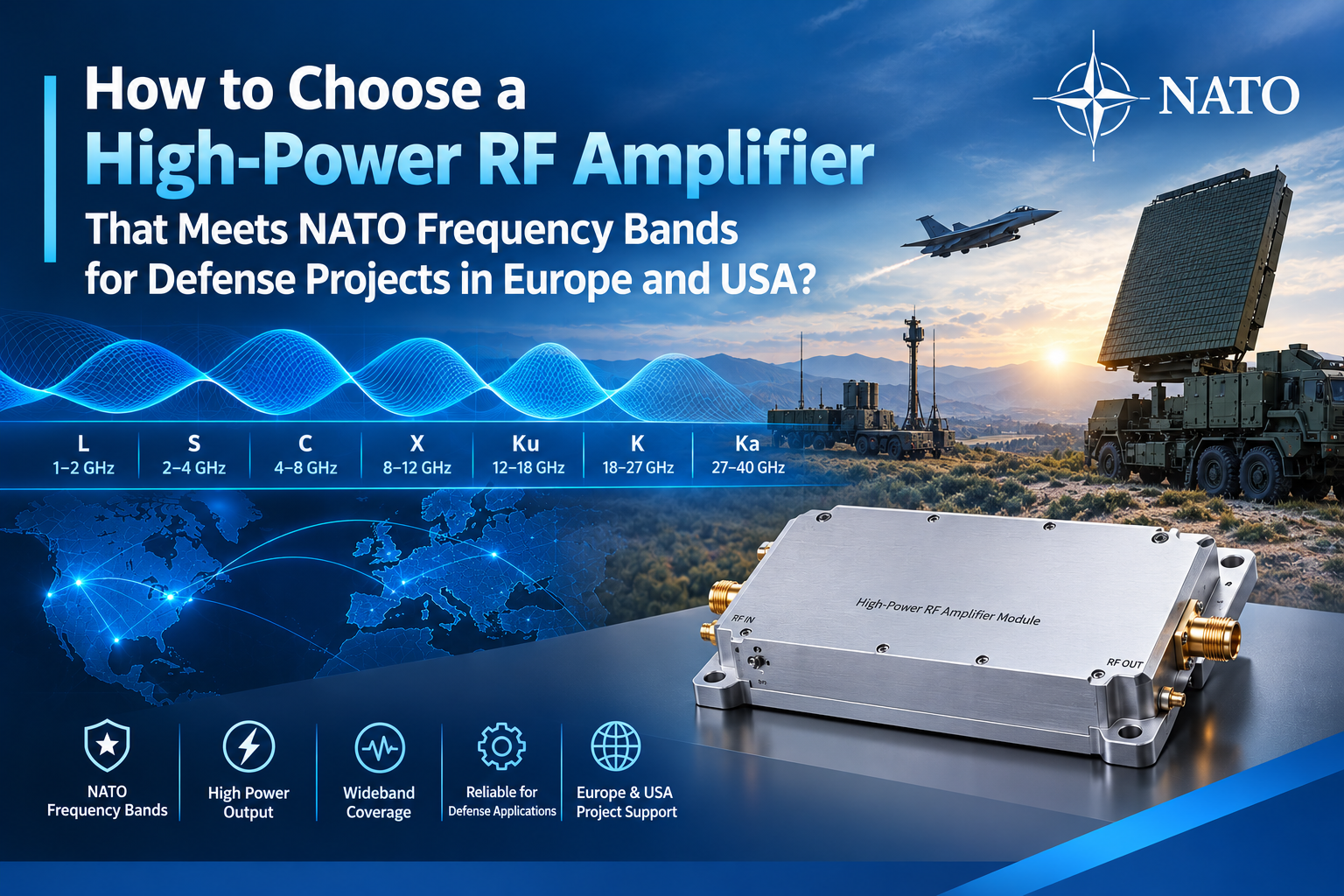
MMIC RF Power Amplifiers span a broad spectrum, from L-band (1-2 GHz) to W-band (75-110 GHz) and beyond.
In lower ranges like S-band (2-4 GHz) and C-band (4-8 GHz), they support radar and satellite uplinks. X-band (8-12 GHz) and Ku-band (12-18 GHz) are popular for defense and satcom, with MMICs handling up to 20W output. K-band (18-27 GHz) and Ka-band (26-40 GHz) cater to 5G backhaul and high-throughput satellites. Millimeter-wave bands (30-300 GHz) are increasingly addressed with GaN and InP MMICs for ultra-high-speed data links.
Broadband MMICs cover octaves or more, using distributed amplifier topologies to maintain flat gain across wide ranges, essential for electronic warfare systems.
What Power Levels Can MMIC RF Power Amplifiers Deliver?
Power output varies by technology and application.
Low-power MMICs deliver 10-500 mW for receiver front-ends or small transmitters. Medium-power units, often GaAs-based, provide 1-10W, suitable for phased arrays. High-power GaN MMICs push boundaries, offering 20-100W in pulsed modes for radar.
In continuous wave (CW) operation, outputs typically range from 5-50W, limited by thermal dissipation. Power combining techniques, like spatial or corporate combiners, scale outputs to kilowatts in arrays.
How Efficient Is a MMIC RF Power Amplifier?
Efficiency in MMIC RF Power Amplifiers is measured by PAE, which accounts for input power, output power, and DC consumption. Typical PAE ranges from 20-60%, depending on RF power amplifier class and technology.
Class-A designs hover around 25-50%, prioritizing linearity. Class-AB achieves 40-60%, balancing efficiency and distortion. High-efficiency modes like Class-E or F can reach 70-80% by shaping waveforms to minimize overlap between voltage and current.
GaN MMICs often exceed 50% PAE in broadband applications, outperforming GaAs. Factors like back-off for linearity reduce average efficiency in modulated signals, prompting techniques like Doherty architectures for 40-50% average PAE in 5G.
How to Design with a MMIC RF Power Amplifier?
Designing with an MMIC RF Power Amplifier involves several steps. Start with system requirements: frequency, power, gain, and linearity.
Select an appropriate MMIC based on datasheets, considering PAE, P1dB (1 dB compression point), and IP3 (third-order intercept). Use simulation tools like ADS or HFSS to model the RF power amplifier circuit, including matching networks if not fully integrated.
Incorporate biasing: stable voltage/current sources prevent oscillations. Thermal design is crucial—use heat sinks or vias for dissipation. Layout considerations include grounding to avoid instability.
Prototype and RF power amplifier test for gain flatness, return loss, and harmonics. Iterate using vector network analyzers and spectrum analyzers.
What Are Common Applications of MMIC RF Power Amplifiers?
MMIC RF Power Amplifiers are pivotal in diverse fields.
In telecommunications, they drive 5G base stations for massive MIMO, enabling high data rates. Satellite communications rely on them for uplink/downlink amplification, ensuring signal integrity over vast distances.
Radar systems, including automotive and military, use MMICs for phased arrays, providing precise beamforming. Electronic warfare employs broadband MMICs for jamming. Wireless infrastructure, like Wi-Fi access points, benefits from their compactness.
MMIC RF Power Amplifier vs. Discrete RF Power Amplifier
MMIC RF Power Amplifiers integrate everything on-chip, offering smaller size, lower parasitics, and easier assembly compared to discrete versions, which use separate transistors and passives.
Discretes excel in high-power applications (>100W) due to better thermal handling and customization. MMICs provide better repeatability and high-frequency performance but may cost more for low volumes and have power limits.
Discretes allow modular upgrades, while MMICs suit volume production in compact systems. Thermal management is trickier in MMICs due to concentrated heat.
Common Problems and Design Challenges
Key challenges include thermal runaway, where heat causes performance drift or failure. Solutions involve substrate selection and cooling.
Instability from oscillations requires careful grounding and decoupling. Linearity issues in high-power modes generate harmonics; predistortion helps.
Matching at mmWave is sensitive to tolerances. Supply noise can degrade PAE—use regulators. Reliability under high power stresses demands robust materials.
How to Choose the Right MMIC RF Power Amplifier
Selection starts with specs: frequency range, output power, gain, PAE, and linearity (IMD, ACPR).
Consider environmental factors: temperature range, vibration. Evaluate package type for integration—QFN for surface mount. Budget and volume matter; custom MMICs for specialized needs. Review vendor reliability data, like MTBF. Simulate candidates in your system.
Conclusion
MMIC RF Power Amplifiers represent a cornerstone of modern RF engineering, blending compactness, efficiency, and performance. From design fundamentals to real-world applications, understanding these devices empowers engineers to build advanced systems.
As technologies like 5G and beyond evolve, MMICs will continue to drive innovation in high-frequency power amplification. As a leading RF power amplifier manufacturer, ZR Hi-Tech provides a range of MMIC options tailored to demanding applications-just contact us!