Newsroom
Wideband RF Power Amplifier: Design Principles, Applications, and Selection Guide
In the rapidly evolving field of radio frequency (RF) engineering, wideband RF power amplifiers stand out as critical components that enable high-performance signal amplification across broad frequency spectra. These devices are essential for applications requiring versatility and reliability in handling diverse signals without compromising on power or efficiency.
This article delves into the design principles, operational mechanics, key specifications, and practical considerations for wideband RF power amplifiers, providing a comprehensive guide for engineers and system designers.
What Is a Wideband RF Power Amplifier?
A wideband RF power amplifier is an electronic device designed to boost the power of RF signals over an extensive frequency range, typically spanning multiple octaves or covering fractional bandwidths exceeding 20-30%. Unlike narrowband amplifiers optimized for specific frequencies, wideband variants maintain consistent performance—such as gain, linearity, and efficiency—across a broad spectrum, often from hundreds of MHz to several GHz. For instance, a typical wideband amplifier might operate effectively from 100 MHz to 6 GHz, making it suitable for multi-band systems.
At its core, a wideband RF power amplifier consists of active semiconductor devices, such as RF power amplifier transistors, integrated with impedance matching networks to ensure efficient signal transfer. The “wideband” designation is relative; in RF contexts, it implies a bandwidth large enough to encompass multiple communication bands, radar frequencies, or test scenarios. This broad operational range distinguishes it from specialized amplifiers, allowing for flexibility in dynamic environments where frequency agility is paramount.
Wideband RF power amplifiers are commonly used in scenarios where signal integrity must be preserved over varying frequencies, such as in software-defined radios or electronic warfare systems. Their design often incorporates advanced materials like gallium nitride (GaN) or gallium arsenide (GaAs) to achieve high power densities and thermal stability.
How Does a Wideband RF Power Amplifier Work?
The operation of a wideband RF power amplifier revolves around amplifying weak input signals to deliver high-output power RF amplifier while maintaining signal fidelity across a wide frequency band. The process begins with the input RF signal entering the amplifier through an impedance-matched port. Inside, the signal passes through one or more amplification stages, where active devices like field-effect transistors (FETs) or bipolar junction transistors (BJTs) provide the necessary gain.
Key to wideband performance are the matching networks—typically composed of inductors, capacitors, and transmission lines—that compensate for frequency-dependent impedance variations. For broadband operation, techniques such as distributed amplification are employed, where multiple transistors are configured so their individual responses overlap, creating a seamless wideband coverage. Biasing circuits for RF power amplifier ensure the transistors operate in the desired region, balancing efficiency and linearity.
In practice, the amplifier must manage challenges like intermodulation distortion (IMD) and harmonic generation. Advanced RF power amplifier designs incorporate feedback loops or digital predistortion (DPD) to linearize the output, ensuring the amplified signal remains undistorted. For example, in a 1-6 GHz wideband amplifier, power-added efficiency (PAE) might range from 30-50%, with output powers exceeding 50 dBm in high-power configurations. The output stage delivers the amplified signal to the load, often an antenna or subsequent RF component, with minimal reflection losses achieved through voltage standing wave ratio (VSWR) optimization.
Understanding the load line— the relationship between voltage and current in the transistor—is crucial. Designers work backwards from the output, optimizing for maximum power transfer while minimizing heat dissipation.
Why Are Wideband RF Power Amplifiers Important?
Wideband RF power amplifiers are indispensable in modern RF systems due to their ability to handle diverse frequency requirements without the need for multiple specialized devices. This versatility reduces system complexity, cost, and size, making them ideal for applications like 5G telecommunications, where multiple bands must be supported simultaneously.
The importance of RF power amplifier extends to reliability in harsh environments, such as military radar or satellite communications, where frequency hopping counters interference. By providing high output power with low noise and distortion, these amplifiers ensure signal integrity, enabling longer transmission ranges and higher data rates. In RF power amplifier test and measurement setups, wideband amplifiers facilitate accurate simulation of real-world scenarios across broad spectra.
Moreover, as wireless technologies advance toward 6G and beyond, the demand for efficient, wideband amplification grows, supporting higher bandwidths and multi-functionality in compact form factors.
Key Performance Specifications to Consider
Selecting or designing a wideband RF power amplifier requires careful evaluation of several key specifications to ensure it meets application demands.
Frequency Range
The operational bandwidth defines the amplifier’s usability. Wideband models typically cover octaves, such as 0.5-2.5 GHz or 18-50 GHz, with minimal performance degradation. Fractional bandwidth (FBW) is a common metric, where FBW = (f_high – f_low) / f_center.
Output Power
Measured in dBm or watts, output power indicates the maximum signal strength deliverable to the load. High-power wideband amplifiers can exceed 100 W, but trade-offs with bandwidth often apply.
Gain and Gain Flatness
Gain, in dB, represents signal amplification. Gain flatness ensures uniformity across the band, typically within ±1-2 dB to avoid signal distortion.
Efficiency
Power-added efficiency (PAE) measures how effectively input power converts to output RF power, crucial for battery-operated or heat-sensitive systems. Values above 40% are desirable for wideband designs.
Linearity
Linearity specs like 1 dB compression point (P1dB), third-order intercept point (IP3), and IMD quantify distortion. High linearity is vital for multi-carrier signals to prevent spectral regrowth.
Common Technologies Used in Wideband RF Power Amplifiers
Wideband RF power amplifiers leverage various semiconductor technologies to achieve desired performance.
Gallium Nitride (GaN) on Silicon Carbide (SiC) excels in high-power, high-frequency applications due to its superior thermal conductivity and breakdown voltage, enabling efficiencies over 50% in mmWave bands. Gallium Arsenide (GaAs) offers excellent linearity and low noise for medium-power uses, though it’s less efficient at high powers.
Laterally Diffused Metal-Oxide Semiconductor (LDMOS) provides cost-effective solutions for lower frequencies, with good ruggedness. Silicon Germanium (SiGe) and CMOS variants are emerging for integrated, low-power wideband designs, particularly in 5G front-ends.
Wideband RF Power Amplifier Design Challenges
Designing wideband RF power amplifiers involves balancing conflicting requirements. Bandwidth expansion often reduces efficiency due to impedance matching difficulties over frequency. Thermal management is critical, as high power densities generate significant heat, necessitating advanced cooling.
Linearity versus efficiency trade-offs arise; high-efficiency modes like Class C introduce distortion. Parasitic elements in transistors vary with frequency, complicating matching. Solutions include Doherty architectures for back-off efficiency or predistortion for linearity. Electromagnetic interference (EMI) and stability issues, like oscillations, must be mitigated through careful layout and filtering.
Wideband RF Power Amplifier Classes
RF power amplifier classes define operational modes based on conduction angle.
Class A offers high linearity but low efficiency (~50%), suitable for low-distortion wideband apps. Class AB balances linearity and efficiency (50-70%), common in telecom. Class B provides higher efficiency (~78%) but with crossover distortion.
Class C, with conduction angles <180°, achieves >80% efficiency but poor linearity, used in pulsed systems. Class D RF power amplifier/E/F employ switching for efficiencies >90%, ideal for wideband with harmonic tuning. Doherty configurations enhance back-off efficiency for wideband, variable-envelope signals.
Typical Applications of Wideband RF Power Amplifiers
Wideband RF power amplifiers find use in diverse fields.
In telecommunications, they power base stations for 5G/6G, supporting multi-band MIMO.
Radar systems employ them for broadband RF power amplifier scanning in defense and aviation. Electronic warfare (EW) benefits from frequency agility for jamming.
RF power amplifiers for wireless communications use GaN-based amplifiers for high-throughput links. Test and measurement equipment relies on them for signal generation across spectra. Medical imaging and industrial heating also leverage their power and bandwidth.
How to Choose the Right Wideband RF Power Amplifier
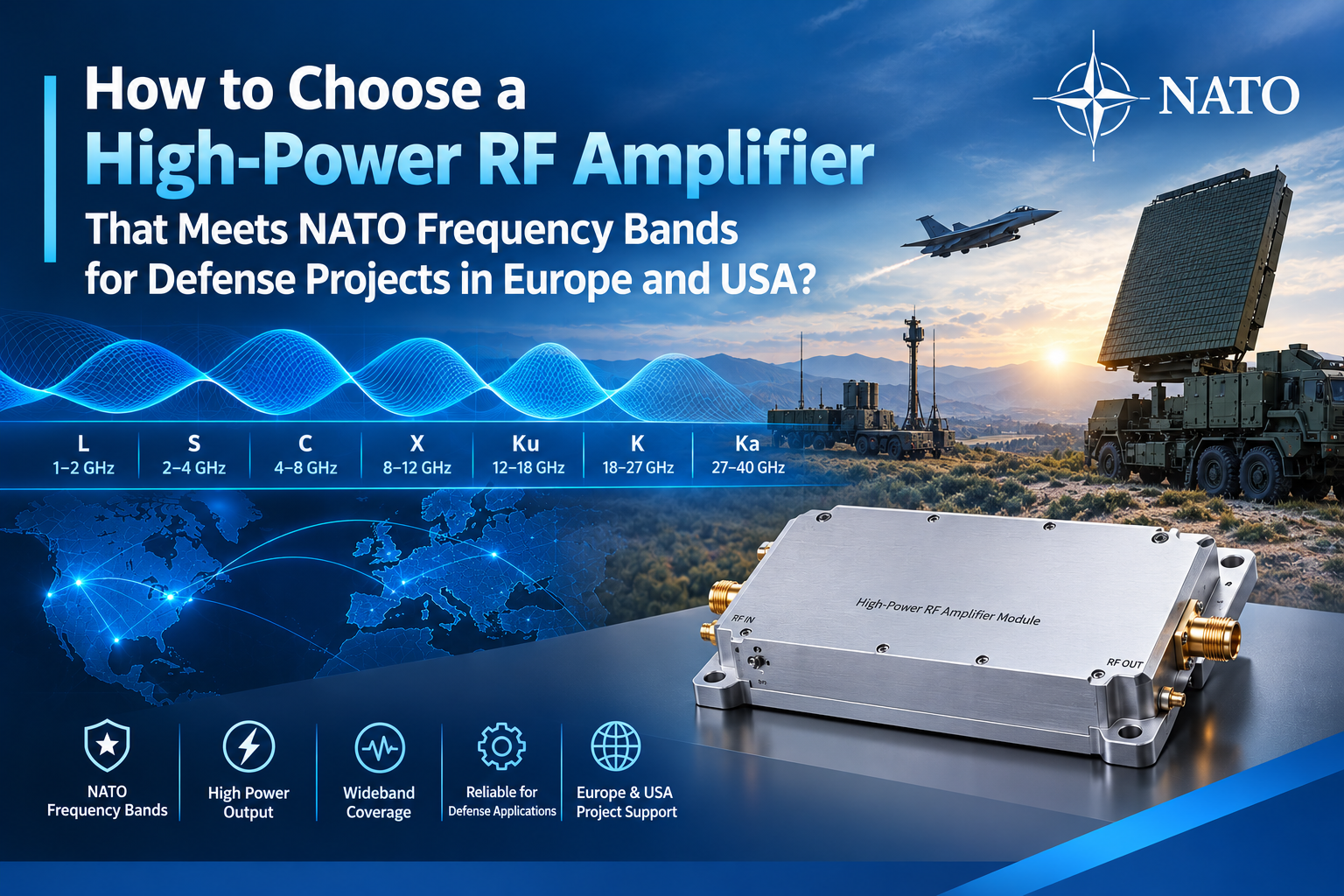
Selection begins with defining requirements: frequency range, power needs, and environmental factors. Evaluate specs like PAE, IP3, and VSWR. Consider integration—RF power amplifier module vs. discrete. Budget for thermal solutions and ensure compliance with standards like MIL-STD. Prototyping and simulation tools aid in verification.
Wideband vs Broadband vs Narrowband RF Power Amplifier
Wideband and broadband terms are often interchangeable, denoting large bandwidths (> octave). Narrowband amplifiers focus on <10% FBW, offering higher efficiency but limited versatility. Wideband sacrifices some gain for breadth, ideal for multi-purpose systems.
Future Trends in Wideband RF Power Amplifier Technology
Emerging trends include GaN integration for mmWave 5G/6G, with PAEs >45% in 18-50 GHz bands. Digital techniques like envelope tracking and AI-optimized predistortion enhance efficiency. Monolithic microwave integrated circuits (MMICs) enable compact, high-power designs. Sustainability drives low-power, recyclable materials. Quantum-inspired amps may emerge for ultra-wideband.
Conclusion
Wideband RF power amplifiers represent a cornerstone of modern RF technology, offering unmatched flexibility and performance. By understanding their principles, challenges, and applications, engineers can harness their potential for innovative systems.
As a leading RF power amplifier manufacturer, ZR Hi-Tech continues to advance these technologies, delivering solutions that meet the demands of tomorrow’s wireless landscape. Whether for telecommunications or defense, selecting the right wideband amplifier ensures optimal system efficiency and reliability–just contact us!