Newsroom
5G Boosts Power Amplifier Demand
1. 5G base stations, significant increase in demand for RF Power Amplifiers
The number of Power Amplifiers in 5G base stations is expected to increase 16 times.4G base stations use a 4T4R scheme. According to three sectors, the corresponding Power Amplifier demand is 12 units. For 5G base stations, 64T64R is expected to become the mainstream scheme. The corresponding Power Amplifier demand can reach as high as 192 units. This results in a significant increase in Power Amplifier quantity.5G base station RF Power Amplifiers are expected to see both volume and price growth. Currently, the power amplifiers used in base stations are mainly based on silicon lateral diffusion metal-oxide-semiconductor (LDMOS) technology. However, LDMOS technology is only suitable for low-frequency bands. It also has limitations in high-frequency applications. Some requirements for 5G base station ZR Hi-tech PAs may include operating frequencies of 3–6 GHz and 24–40 GHz.
The RF power range is typically between 0.2 W and 30 W.5G base station GaN RF Power Amplifiers are expected to gradually become the dominant technology. GaN is more expensive than LDMOS and GaAs. However, it offers excellent high power density and strong high-frequency performance. The simplest way to increase the RF power of a power amplifier is to increase the voltage. This makes gallium nitride transistor technology very attractive. By comparing different semiconductor process technologies, it can be seen that power typically increases with high operating voltage IC technology. The typical processing steps for GaN RF devices mainly include: epitaxial growth, device isolation, ohmic contact (source and drain fabrication), nitride passivation, gate fabrication, field plate fabrication, substrate thinning, and substrate via formation.
2. GaN RF Power Amplifiers are expected to become the mainstream technology for 5G base stations
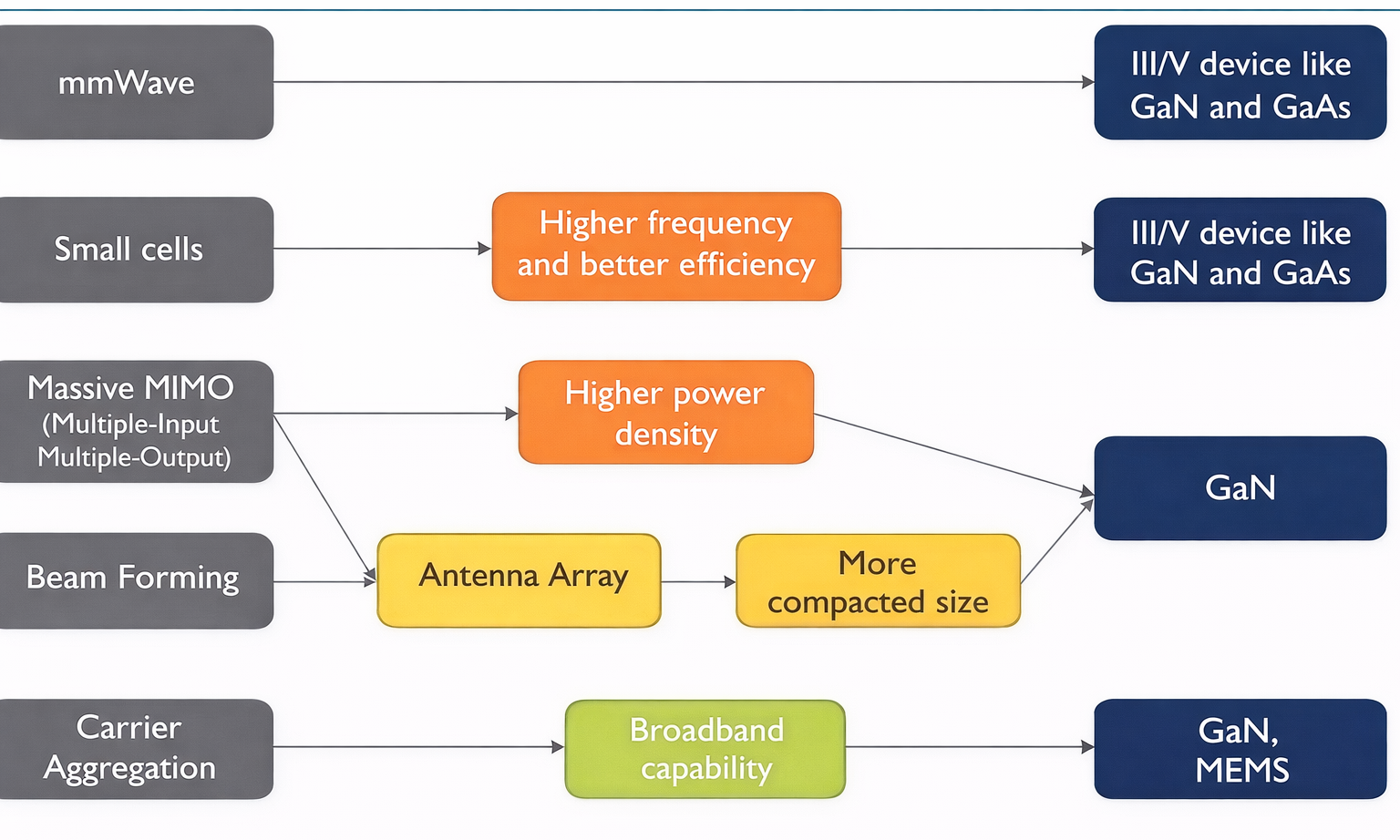
It is predicted that most macro network units below 6GHz in the future will adopt GaN devices. Small base stations will show more obvious advantages with GaAs. In the telecommunications market, thanks to the approaching application of 5G networks, GaN devices are expected to bring huge market opportunities starting from 2019. Compared to existing silicon LDMOS (Laterally Diffused Metal Oxide Semiconductor) and GaAs (Gallium Arsenide) solutions, GaN devices can provide the power and efficiency required for next-generation high-frequency telecommunications networks. Moreover, GaN’s broadband performance is one of the key factors enabling important new technologies. These include multi-band carrier aggregation. GaN HEMT (High Electron Mobility Transistor) has become a candidate technology for future macro base station power amplifiers.
Since LDMOS can no longer support higher frequencies, and GaAs is no longer the optimal solution for high-power applications, GaN is becoming more favorable. It is expected that most macro network unit applications below 6GHz in the future will use GaN devices. The frequency bands used by 5G networks are higher. This results in weaker penetration and coverage compared to 4G. Therefore, small cells will play an important role in 5G network construction. However, small cells do not require very high power. Existing technologies like GaAs still maintain their advantages in such scenarios. At the same time, higher frequencies reduce the coverage of each base station. As a result, more transistors will need to be deployed. Market shipment growth is expected to accelerate.
3. Global GaN RF Device Industry Chain Competitive Landscape
The pace of product launches for GaN microwave RF devices has accelerated significantly. While the microwave RF field is currently attracting considerable attention, its high technological level and significant patent barriers limit the number of companies compared to those in power electronics and optoelectronics. However, most companies in this field possess strong R&D capabilities and market operation skills. The commercial supply of GaN microwave RF devices is developing rapidly. According to data analysis from Mouser, as of April 2018, four manufacturers had launched 150 types of GaN HEMTs. This accounts for 9.9% of the total RF transistor supply, a 0.6% increase from January. Qorvo’s products have the widest operating frequency range. Skyworks’ products have a lower operating frequency. 73% of the products from Qorvo, CREE, and MACOM have output power concentrated between 10W and 100W. The maximum power reaches 1500W, operating at 1.0–1.1GHz, manufactured by Qorvo. These products primarily employ the GaN/SiC GaN technology route.
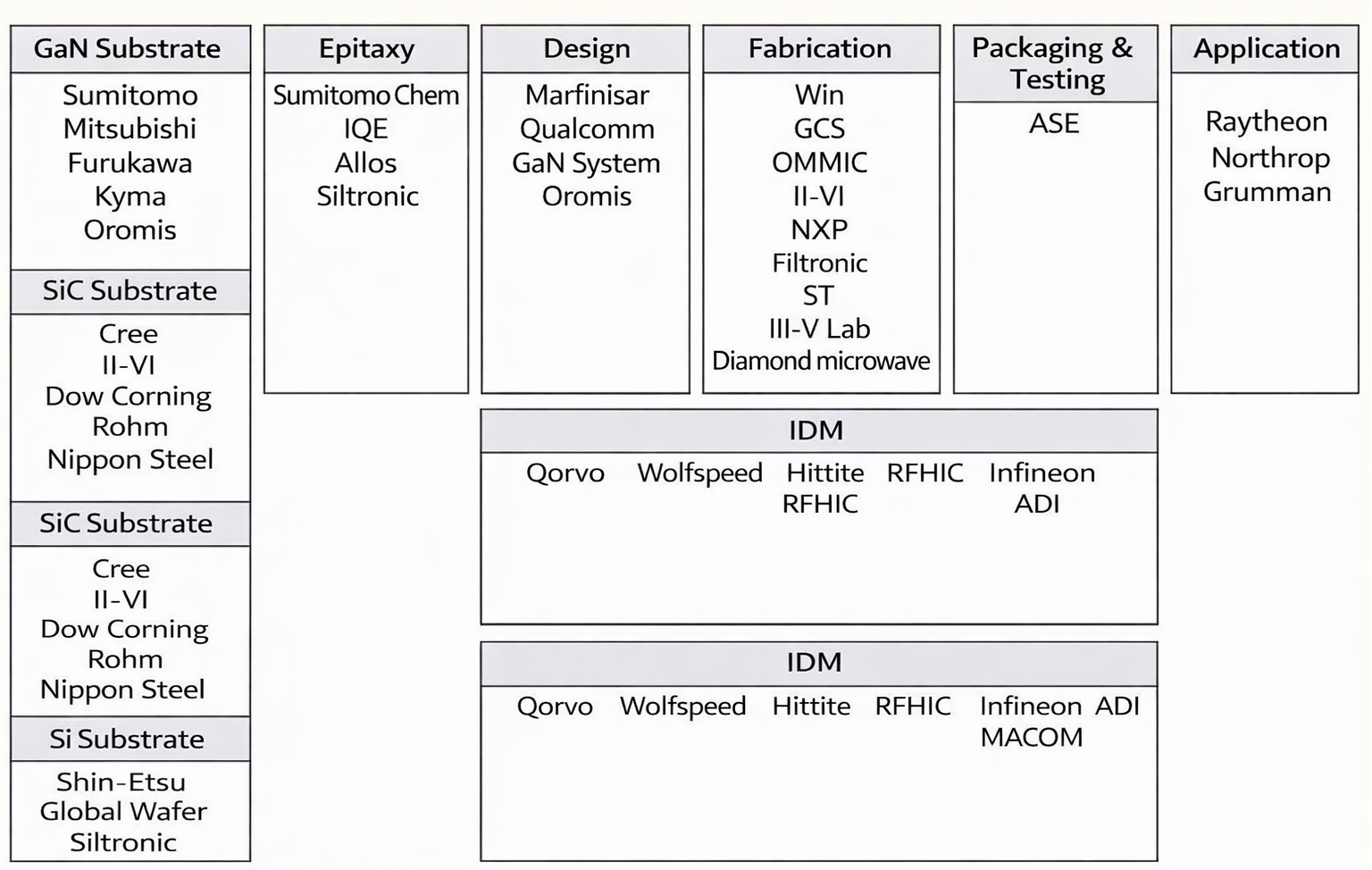
In addition, some companies offer GaN RF module products. Currently, four companies sell GaN RF Power Amplifier. Among them, Qorvo’s products have the widest operating frequency range, reaching up to 31GHz. Skyworks’ products operate at lower frequencies, mainly between 0.05–1.218GHz. Qorvo offers the most diverse range of RF power amplifiers. Within the two 5G operating frequency bands (3.3–3.6GHz and 4.8–5GHz) announced by my country’s Ministry of Industry and Information Technology, Qorvo offers the most diverse range of RF amplifiers. The maximum power reaches 100W and 80W, respectively. In January, Qorvo’s maximum power in the 4.8–5GHz band was 60W. ADI’s maximum power in the 4.8–5GHz band has increased to 50W. Previously, the maximum power of its products was less than 40W. Most other products have power below 50W.